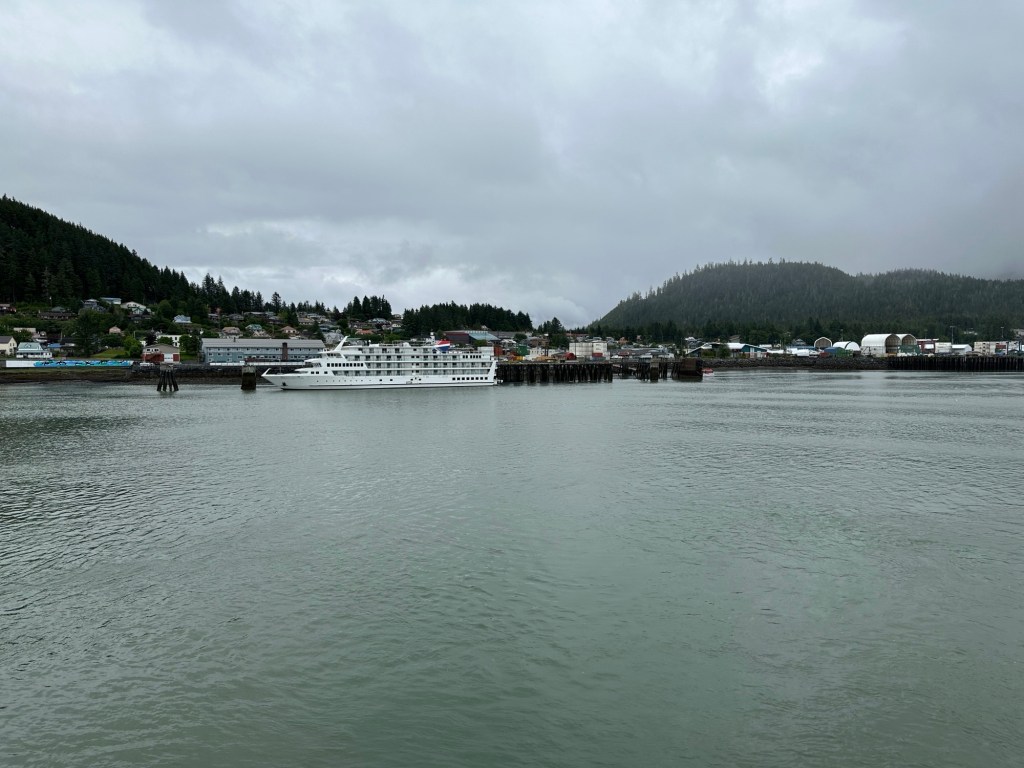
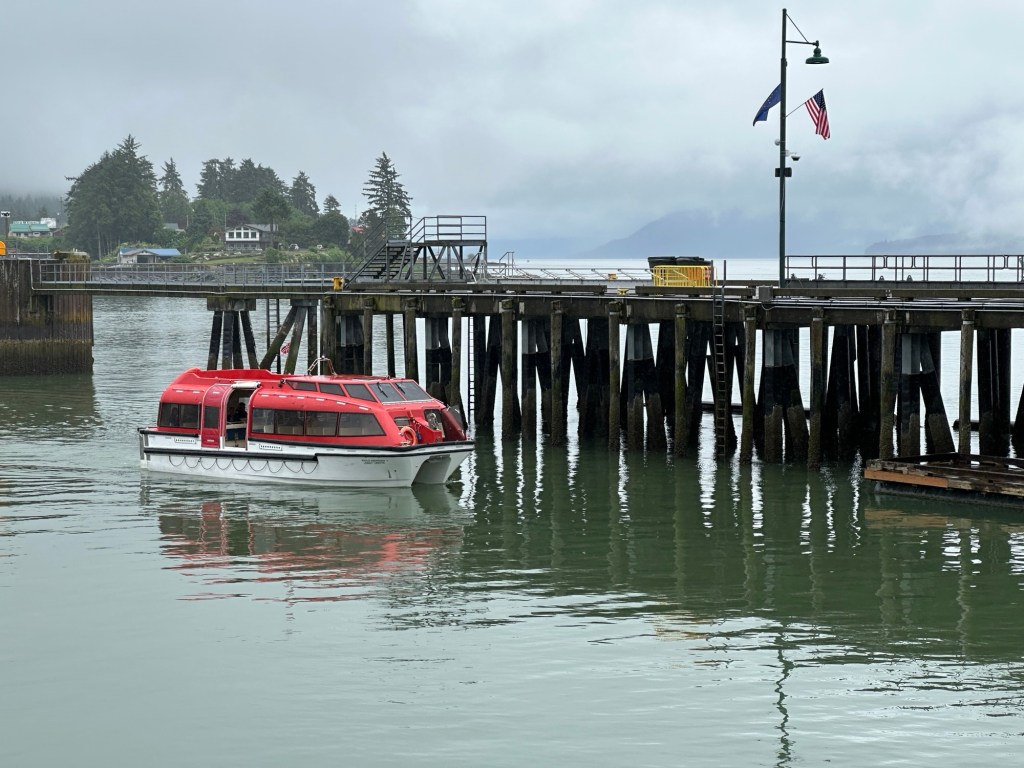
Wrangell, on the north end of Wrangell Island is our first port of the trip. Our ship parked a little ways out from the pier and two tender boats from the ship ferried passengers to and from the dock.
This was our first feet-on-the-ground landing in Alaska. We enjoyed both the town and the hike in the forest emphasizing the botanical uses of plants by the Tlingit people.
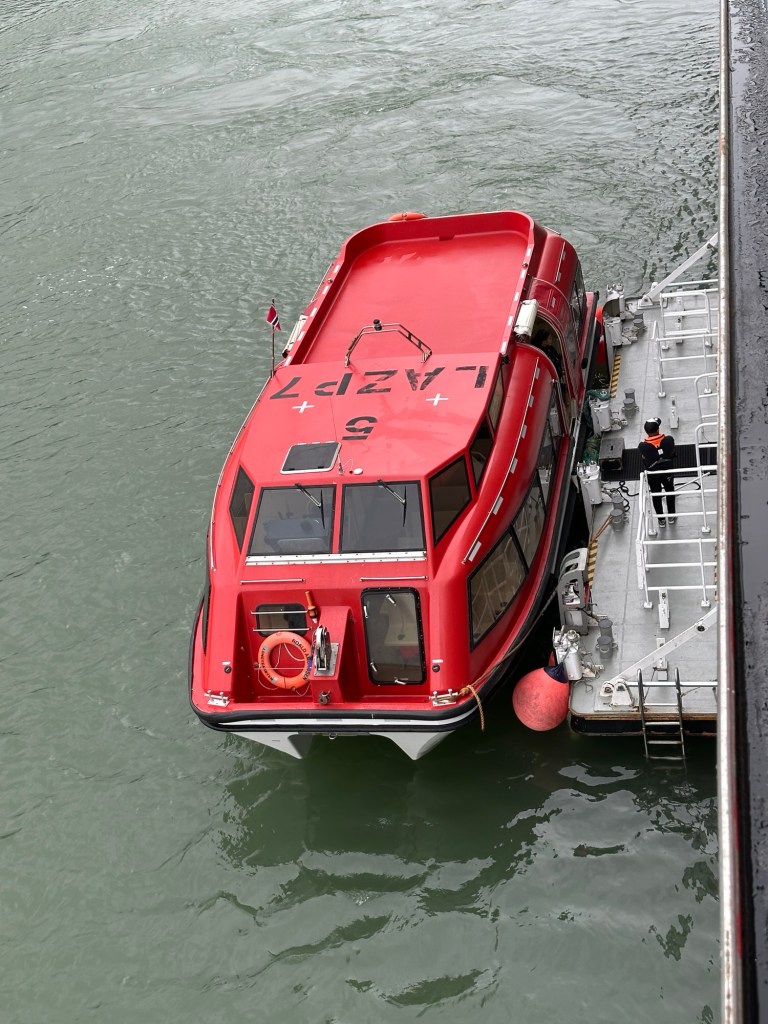
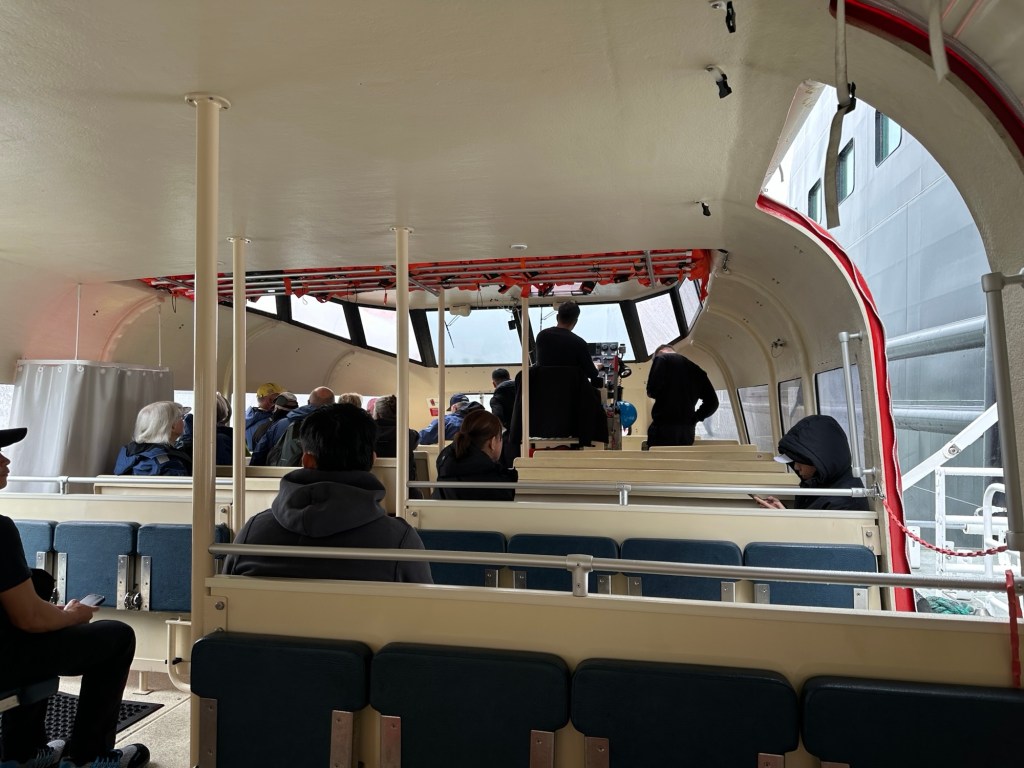
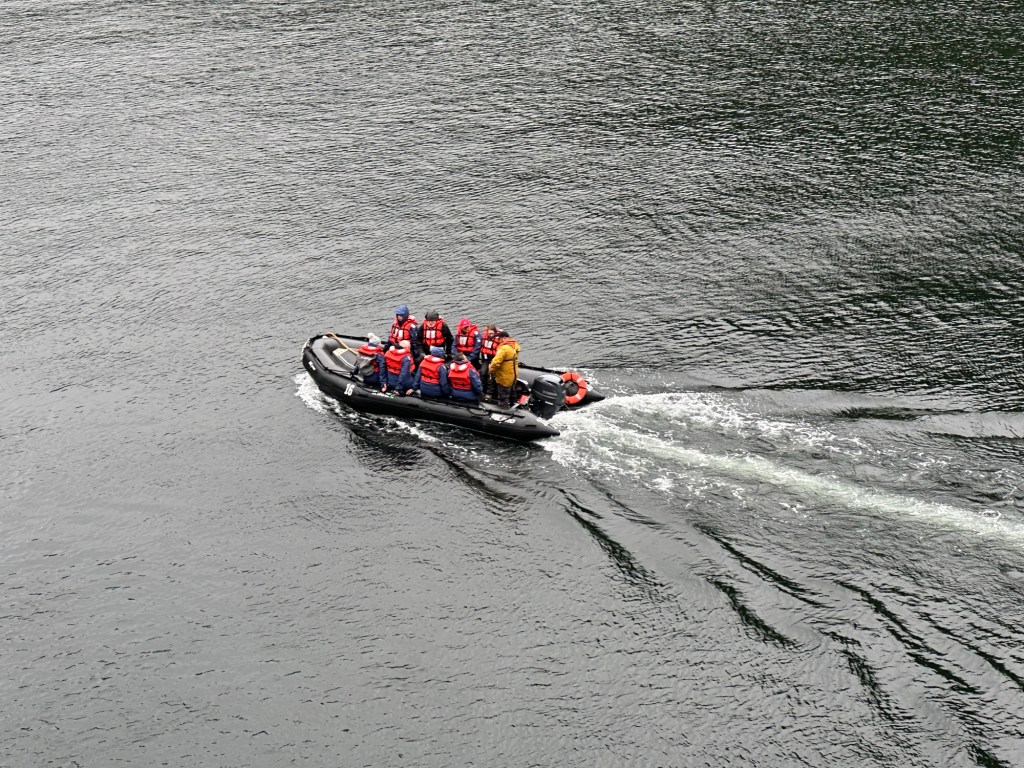
An American cruise ship was at Wrangell at the same time. Top of a tender boat. They seem a bit like floating submarines.On the tender, we didn’t have to bring our life jackets from our room. See how secure they seem? They can be completely enclosed in bad weather.
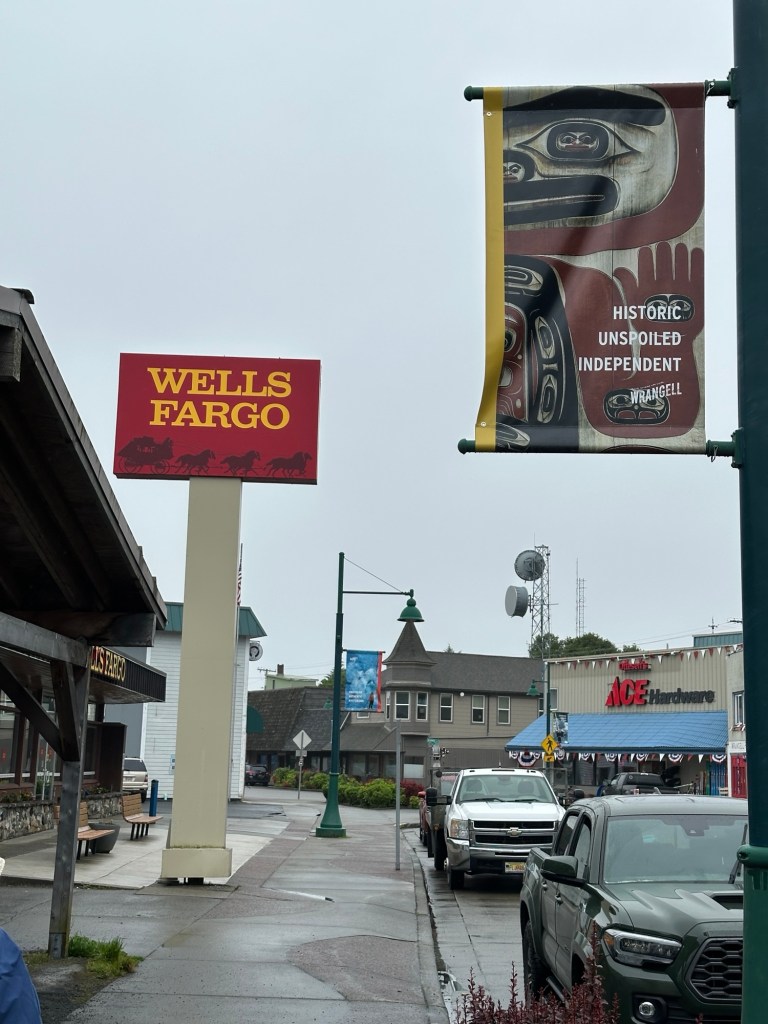
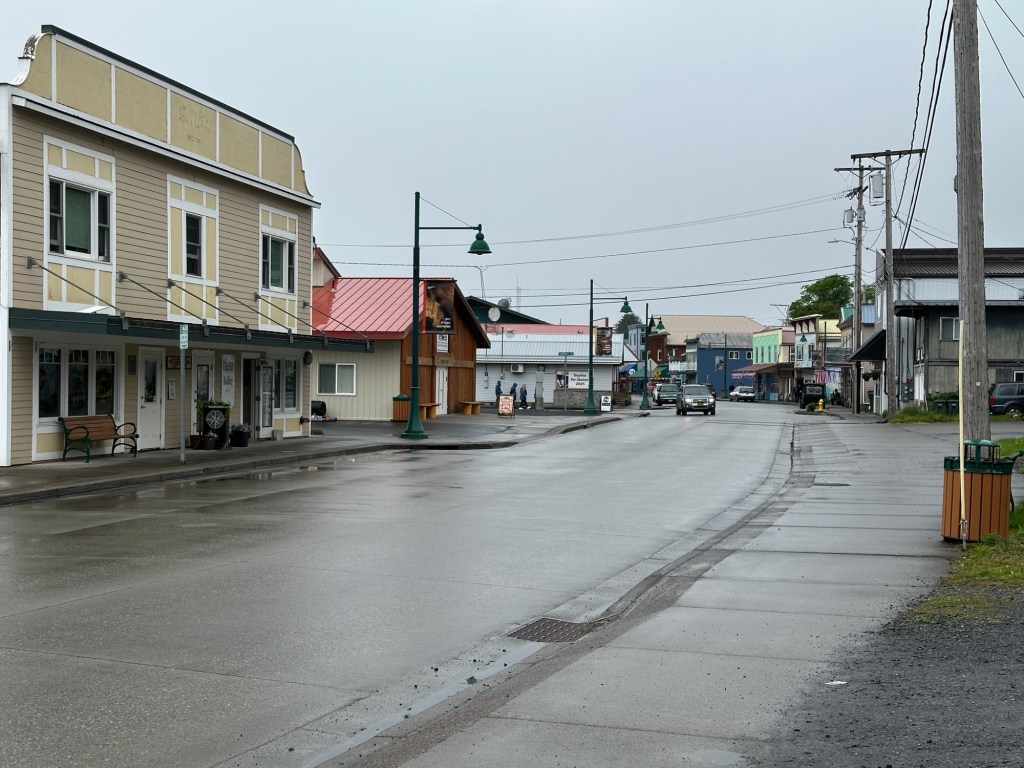
The streets were a lot like any American town. We learned that Wrangell doesn’t get much snow, and when it comes it’s often followed by rain, so snow doesn’t stick around for long.
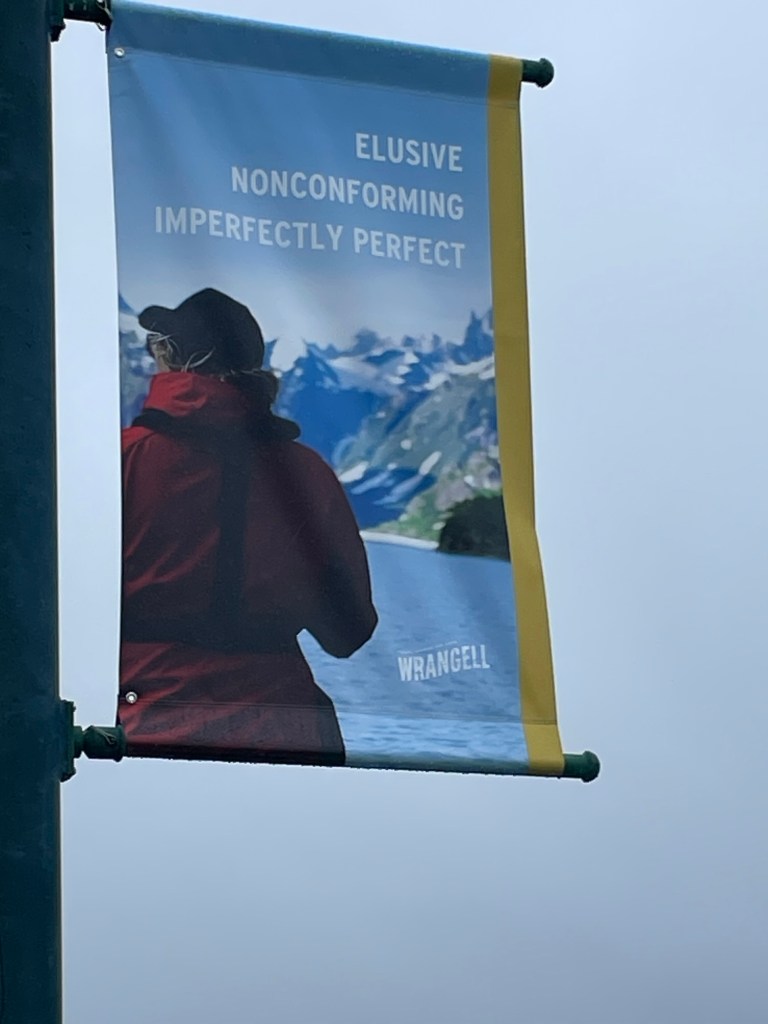
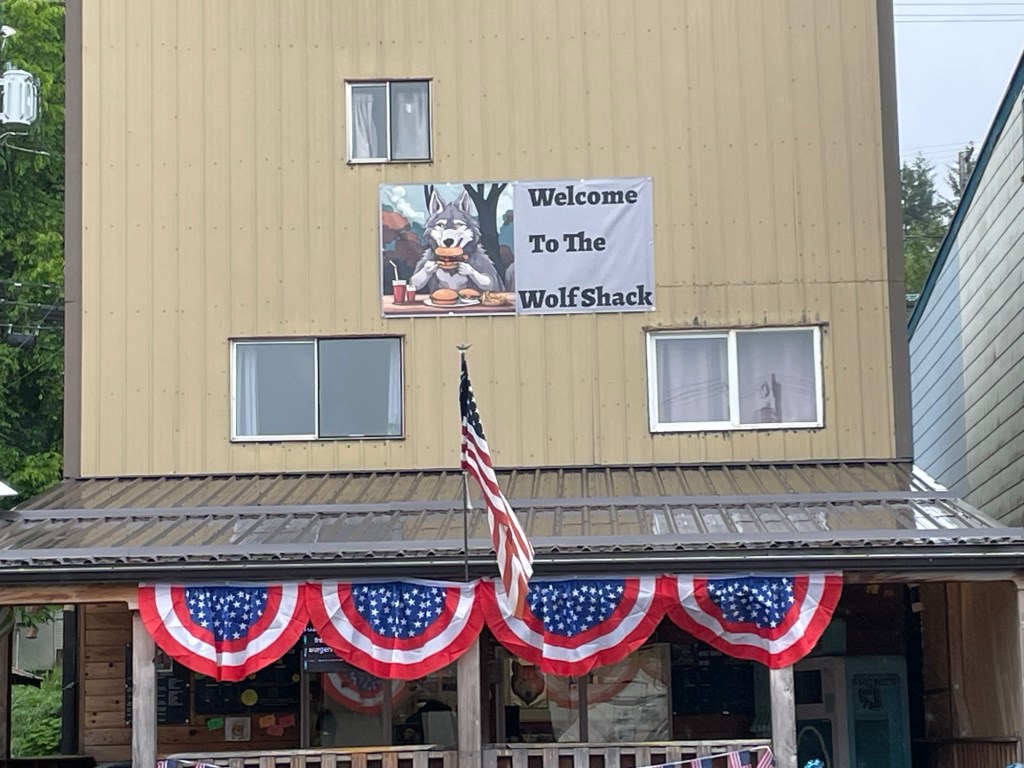
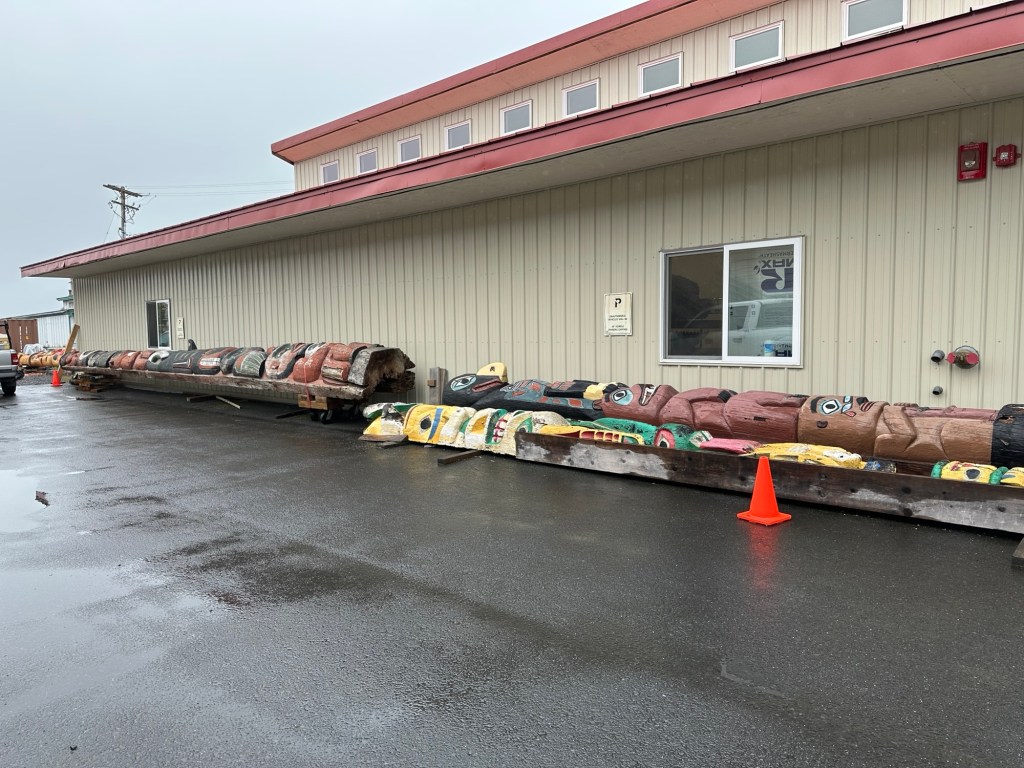
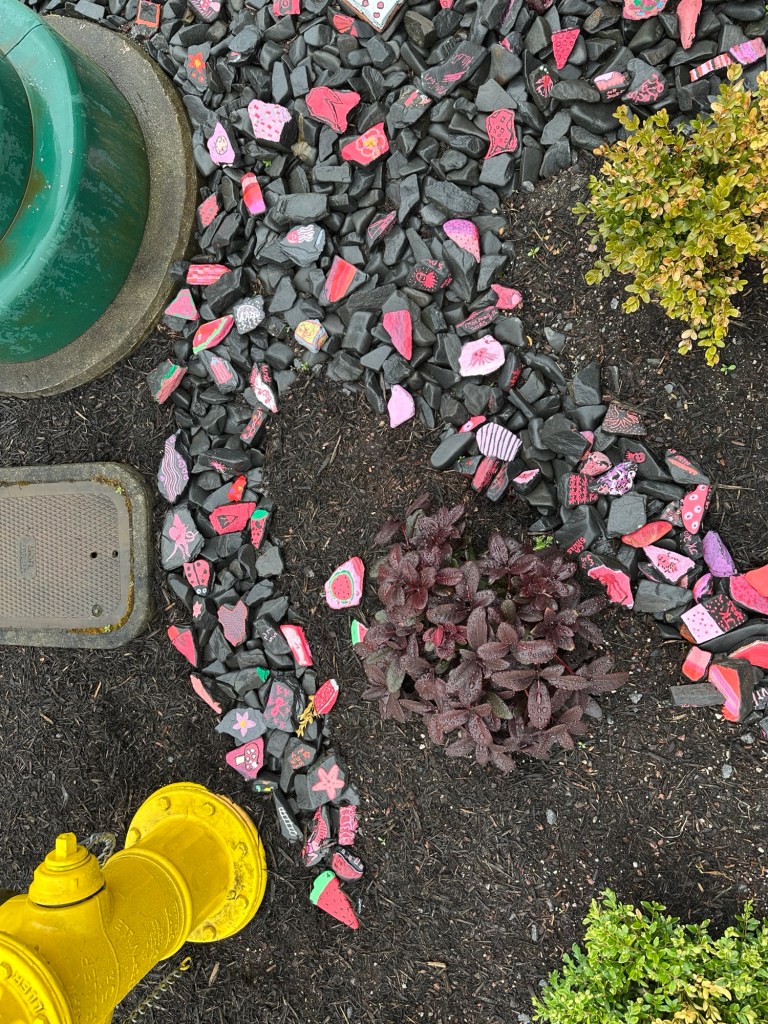
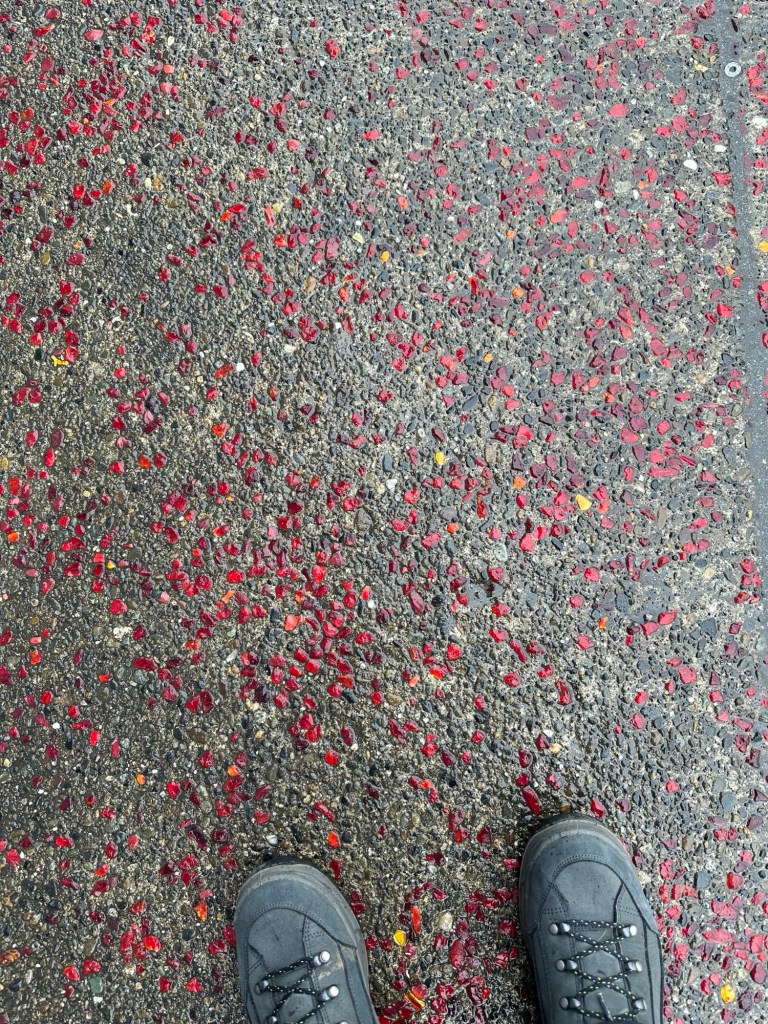
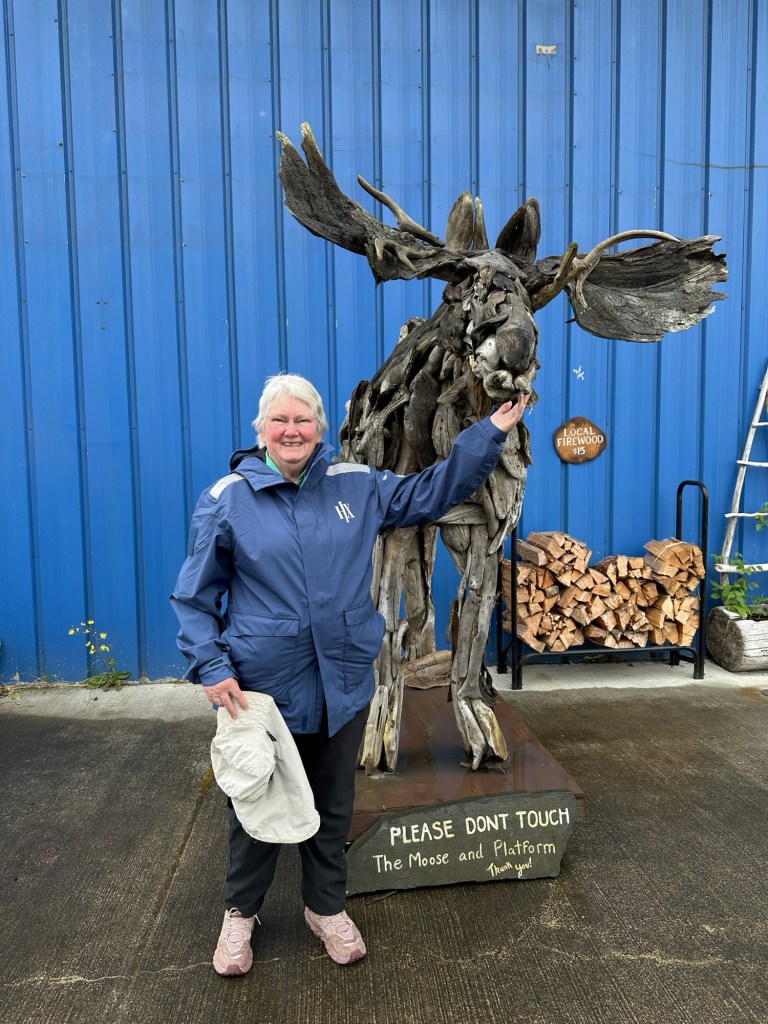
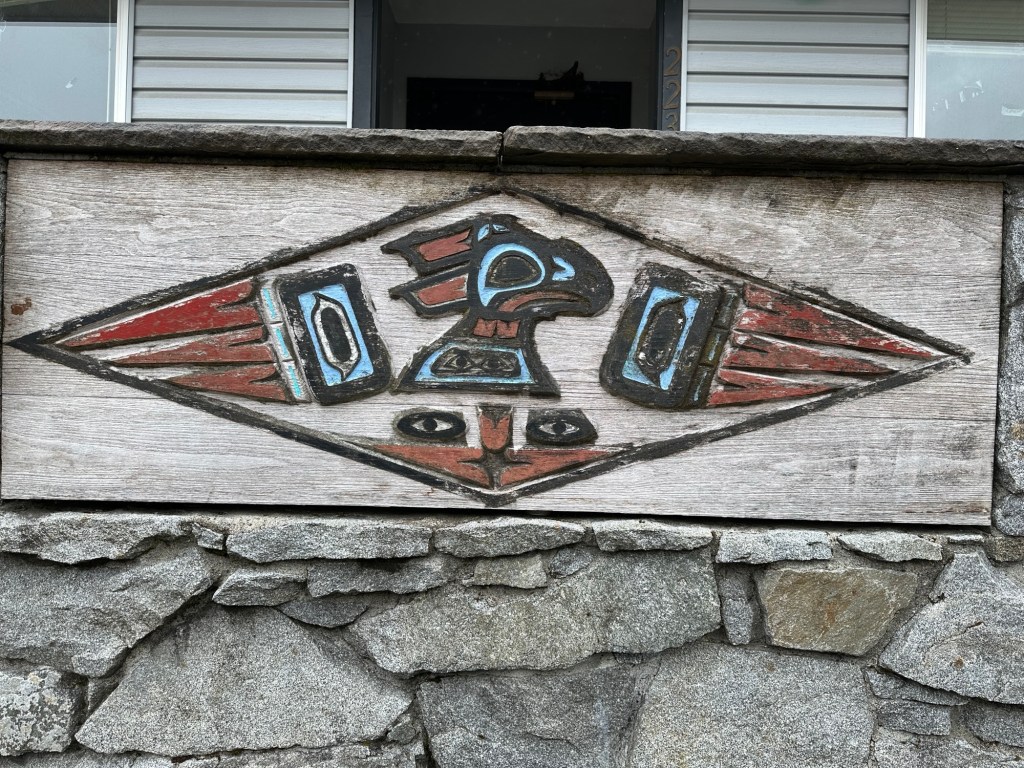
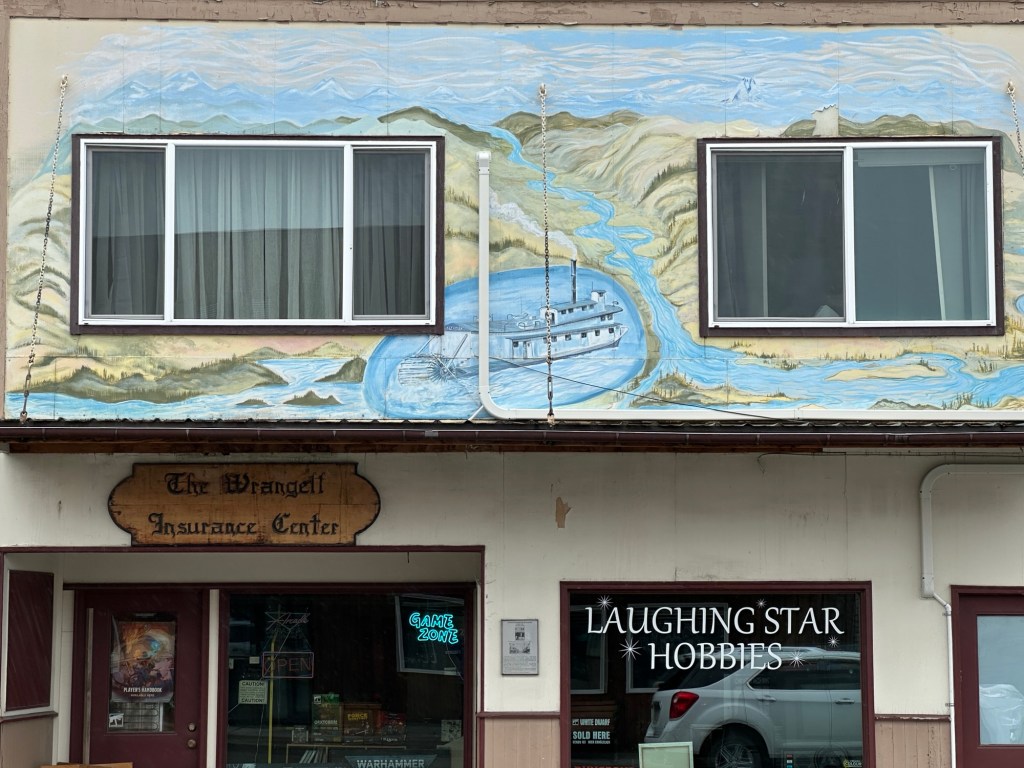
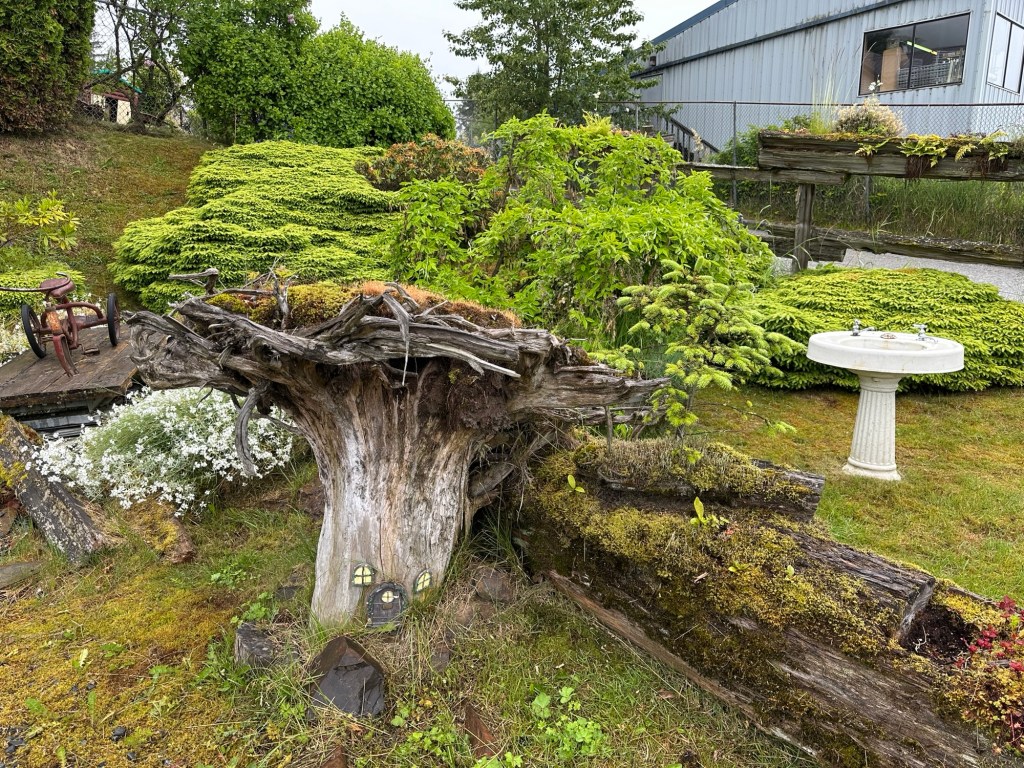
Wrangell has a lot of different flags with fun mottos. Another interesting motto on Main StreetCute wolf flag above bunting getting ready for Independence DayWe were told in one of our lectures that formerly, when old totems fell, the people would let them go to make room for new stories. Now people try to preserve them to remember.Painted rocks remind me of hopeful messages during the pandemic. The sidewalks are made of chips of local black slate and bright red glass, the town colors. Cute moose made out of driftwoodArt carved from woodMural on a building The rain was fairly light, luckily. Fairy house in upside-down tree trunk below Norwegian Spruce.
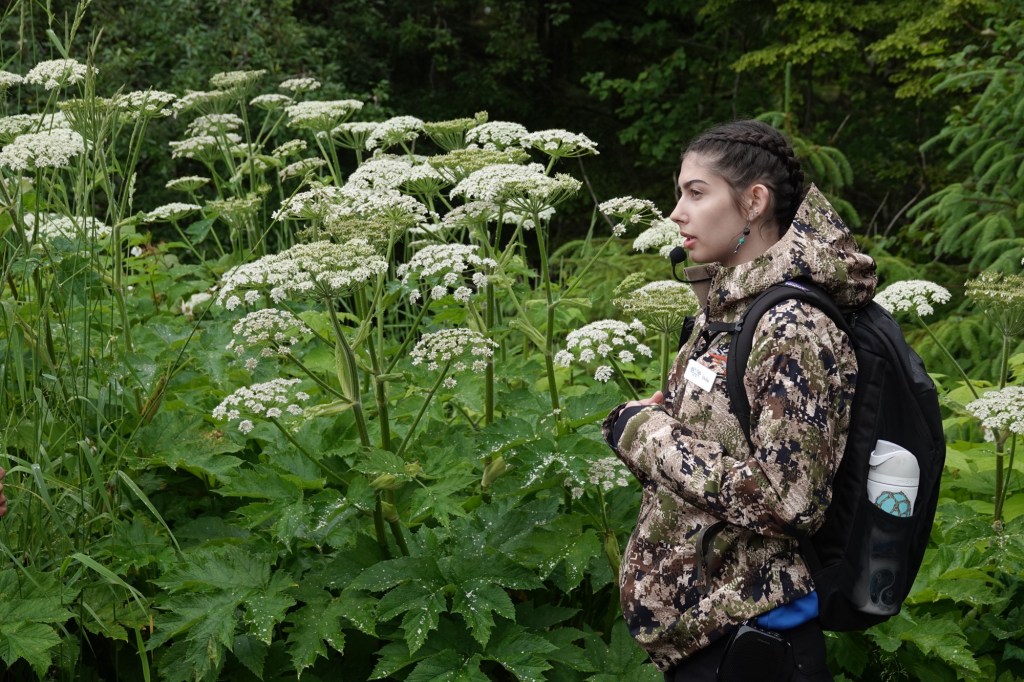
The guide for our forest walk in the gardens was an 18 year-old woman, just graduated from high school with 15 people in her class. Della plans to go to Fort Lewis College in Durango, where our own Checkers got a degree. She wrestles competitively and is planning on majoring in Business Administration. She also really knows her plants and loves her home town.
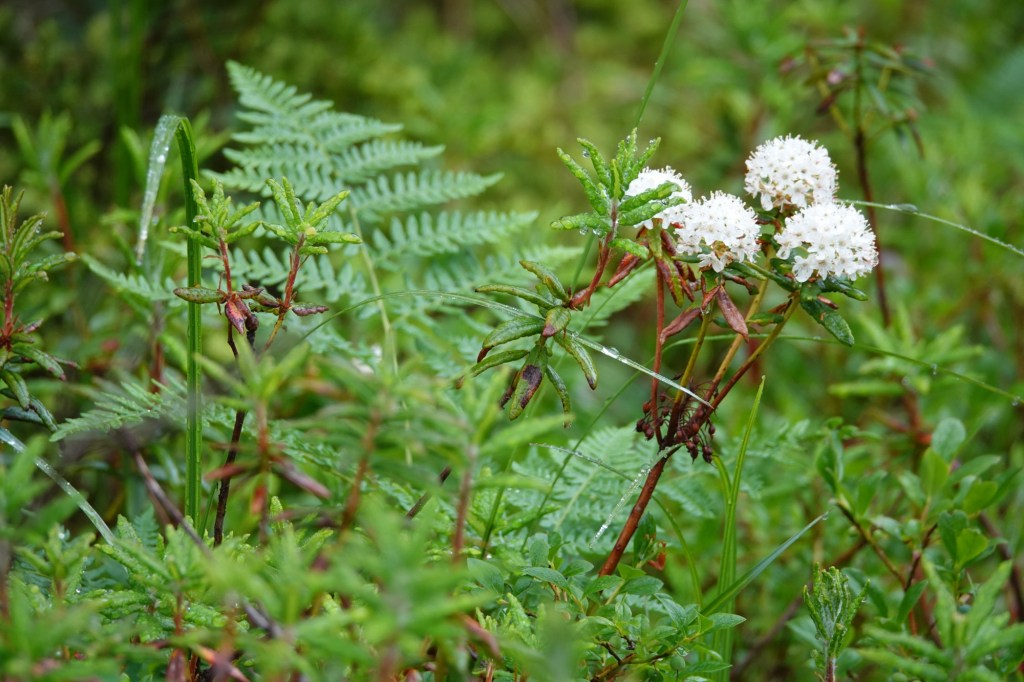
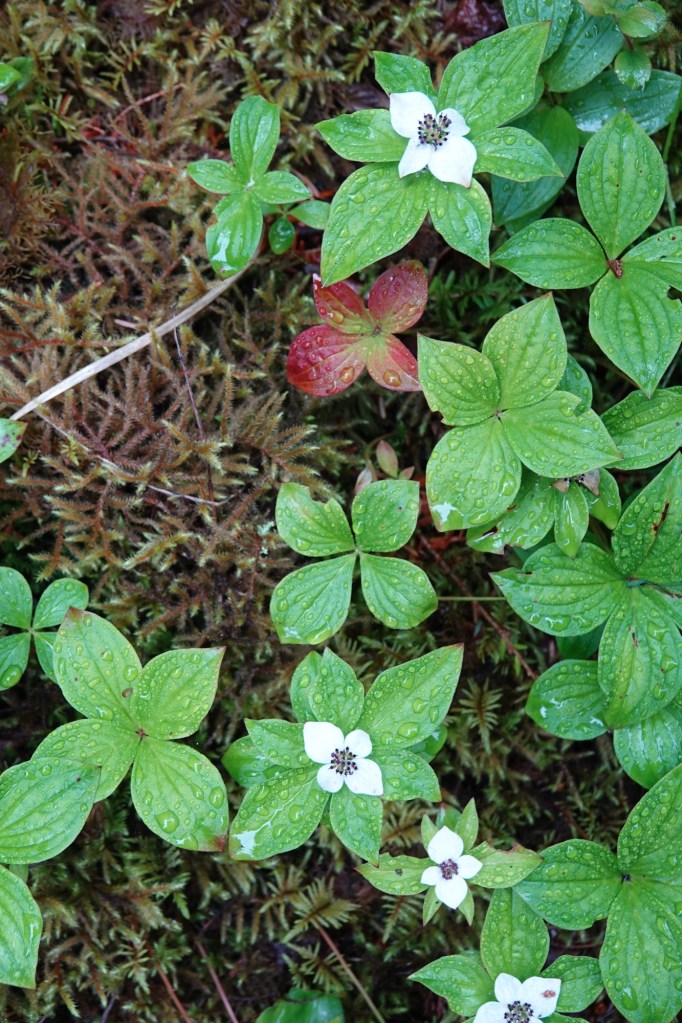
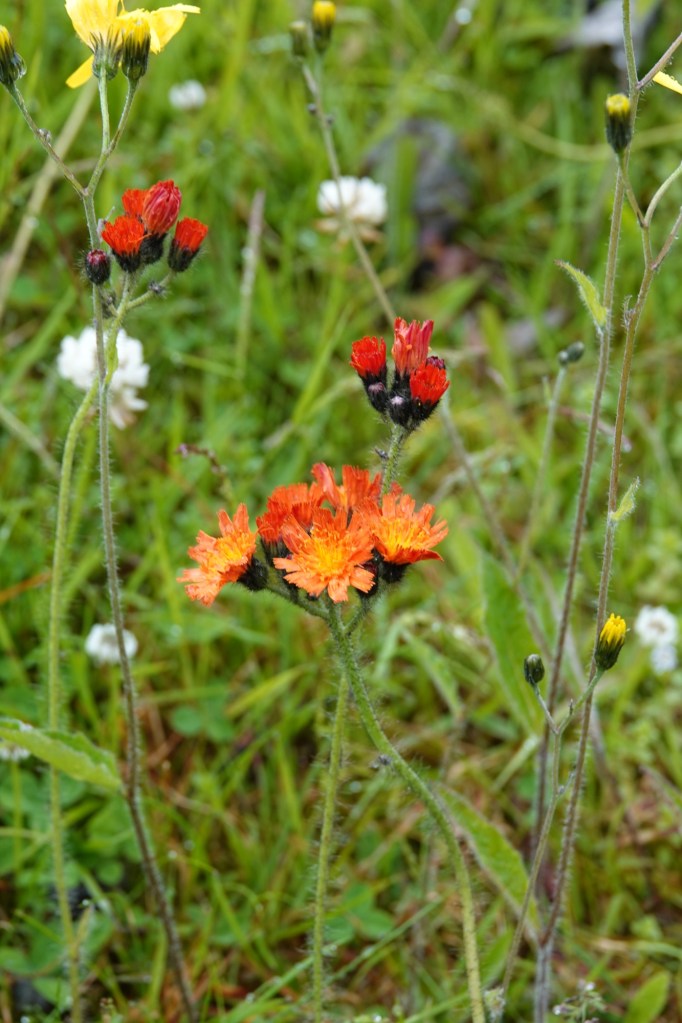
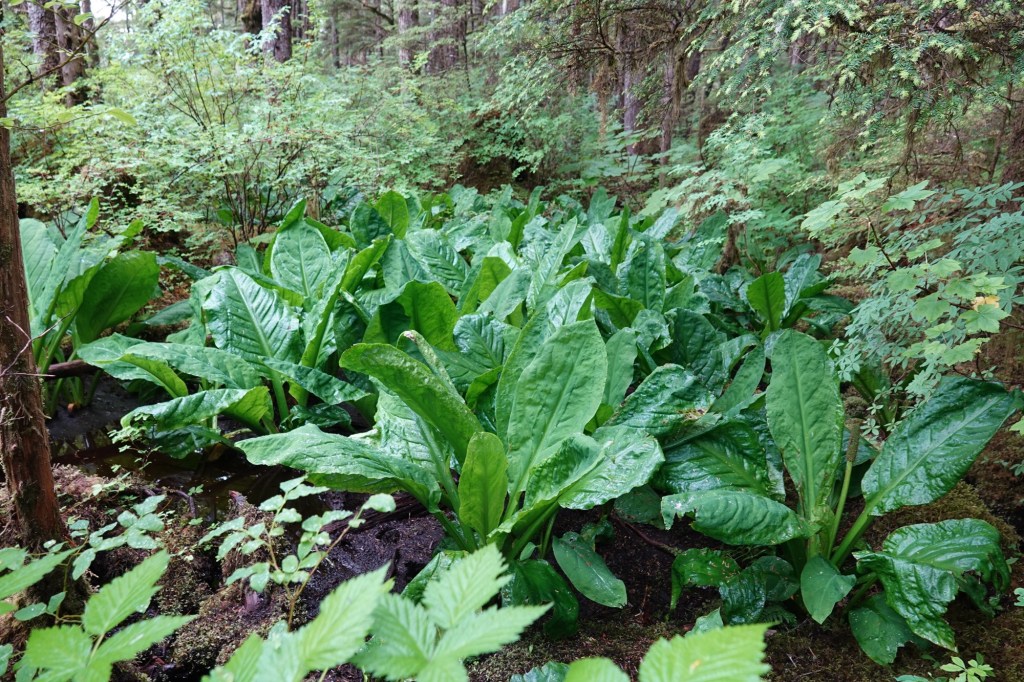
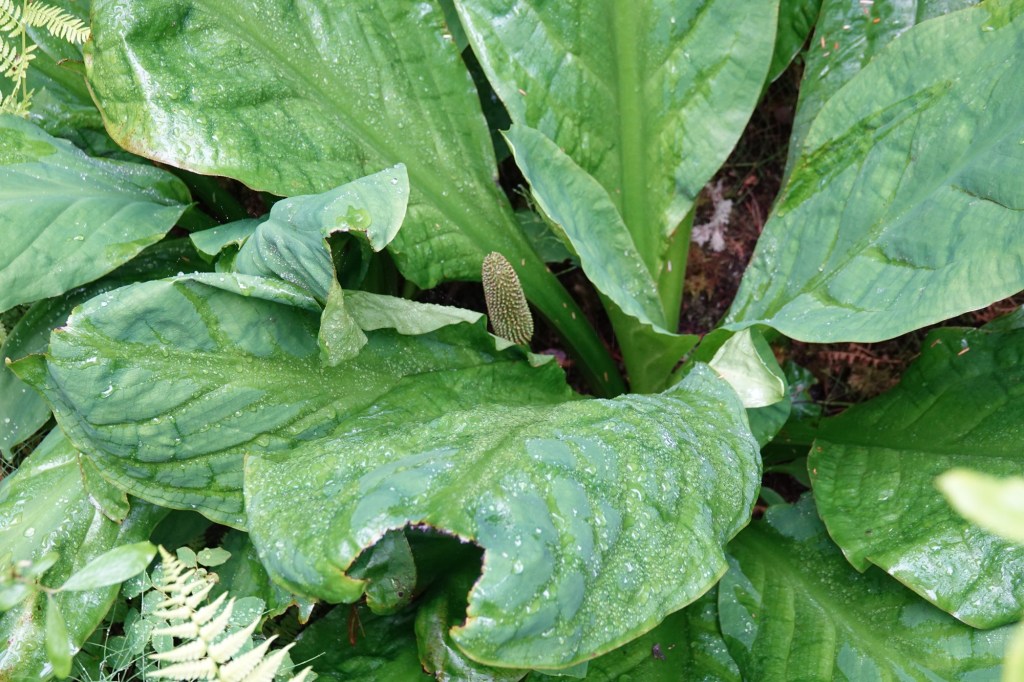
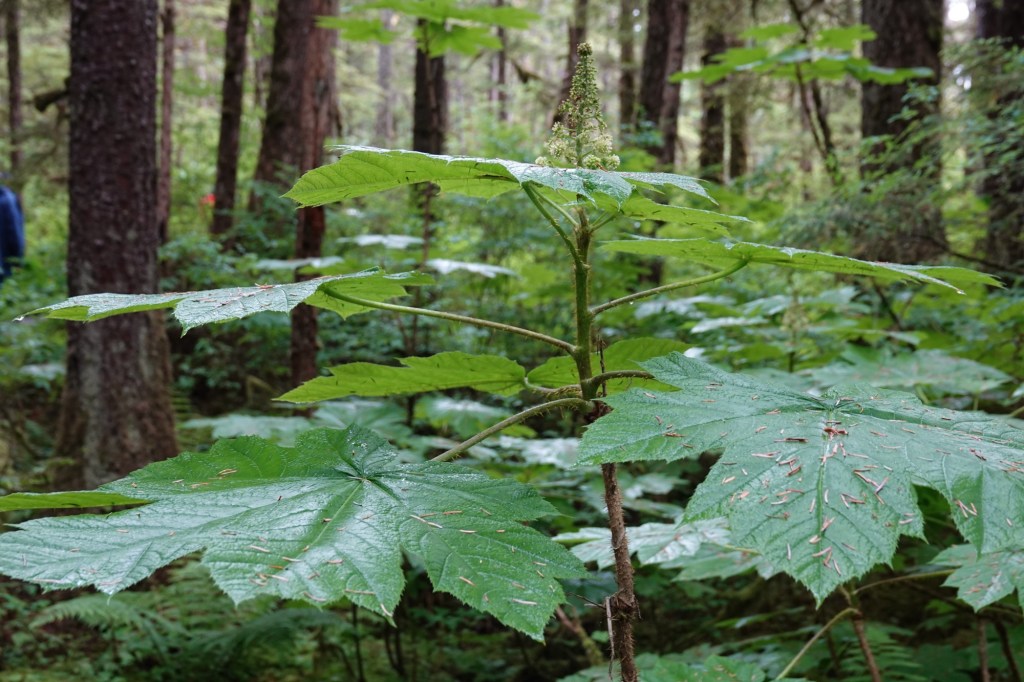
Labrador tea flowers with one of the many varieties of fern. So many kinds of berries! Della told us how the native people used each kind.Della called this a weed, and it does look related to dandelion. Our lovely guide in front of cow parsnip. Skunk cabbageSame, showing the knob of flowers that gives the plant its name.Devil’s Club, a useful plant in many ways.
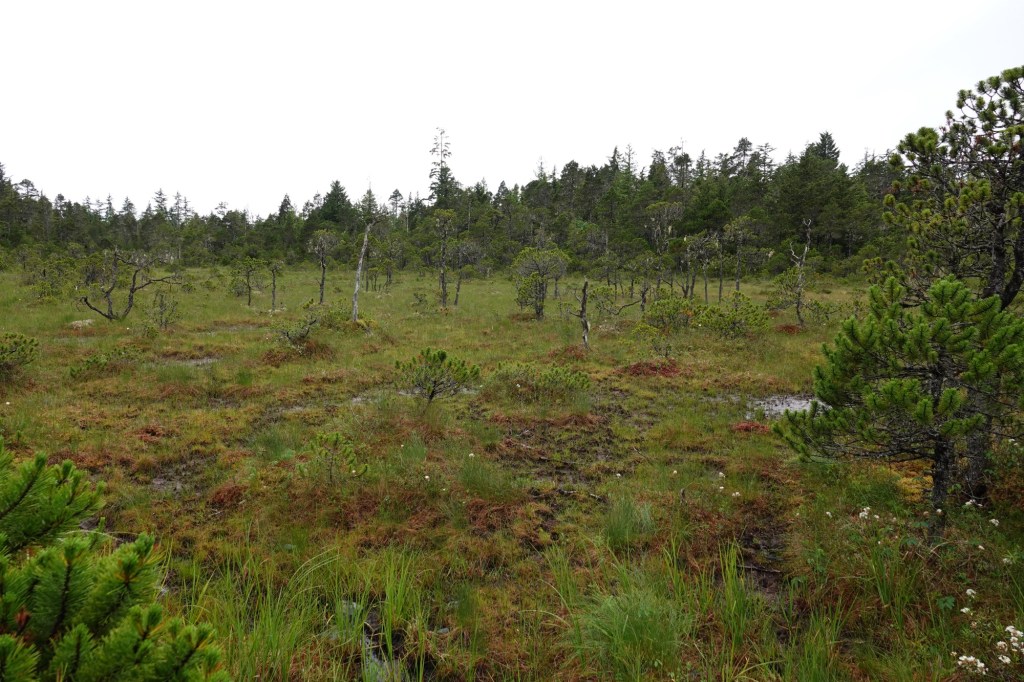
Muskeg, basically a peat bog, hundreds of feet deep. The ground is acidic and almost anoxic, so any tree that gets started growing is stunted like a bonsai tree.
We woke to fog and morning dew. The ship changed time zones early, so that the change would be while we were all sleeping, but our phones and watches did not change right away because we were still in Canada.
Before breakfast, Clare made a water run (the tap water tastes like chlorine). Going past the gym, she noticed that all the equipment was being utilized! Walking, cycling, stair steps, weights, everything. Our fellow travelers are serious about keeping in shape.
Two dolphins tried to keep up with the ship while we were eating breakfast. Such a nice welcome. No camera again.
Most of the day was ocean travel and learning. The experts on this cruise are really good. One guy, Oscar from Mexico, gave us tips on how to more fully utilize our smart phones as cameras (or how he said it, your camera that can also be used as a phone). Even Brian learned things from him, and his presentation was full of humor to keep us listening. Lauren told us about the cultures in Southeastern Alaska. Jake(?) told us about Old Growth Forests, which we would be seeing later in the afternoon.
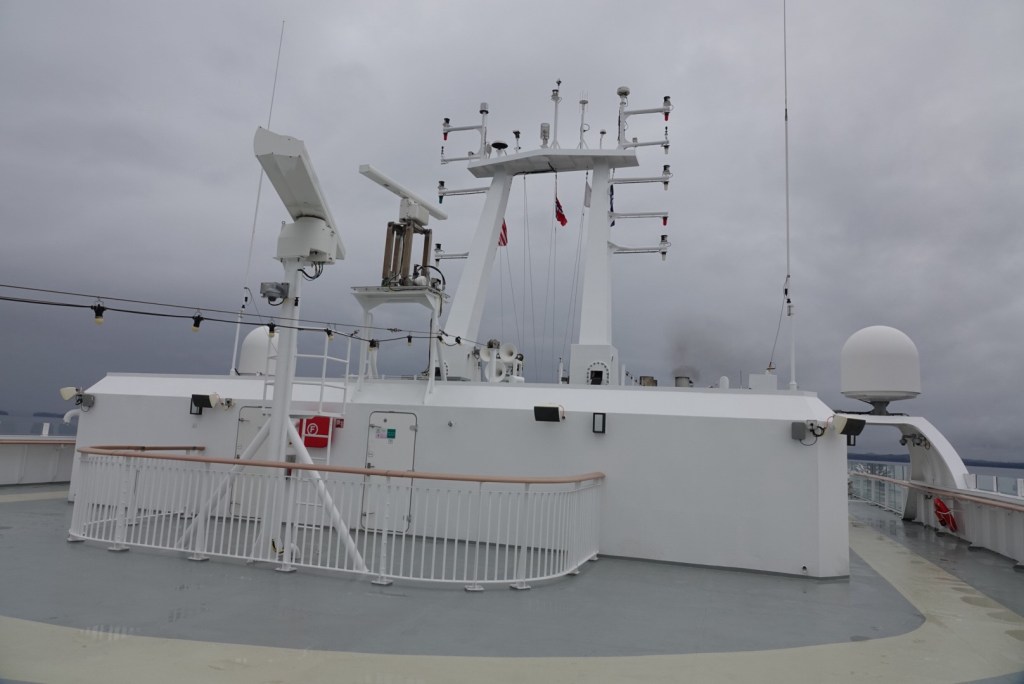
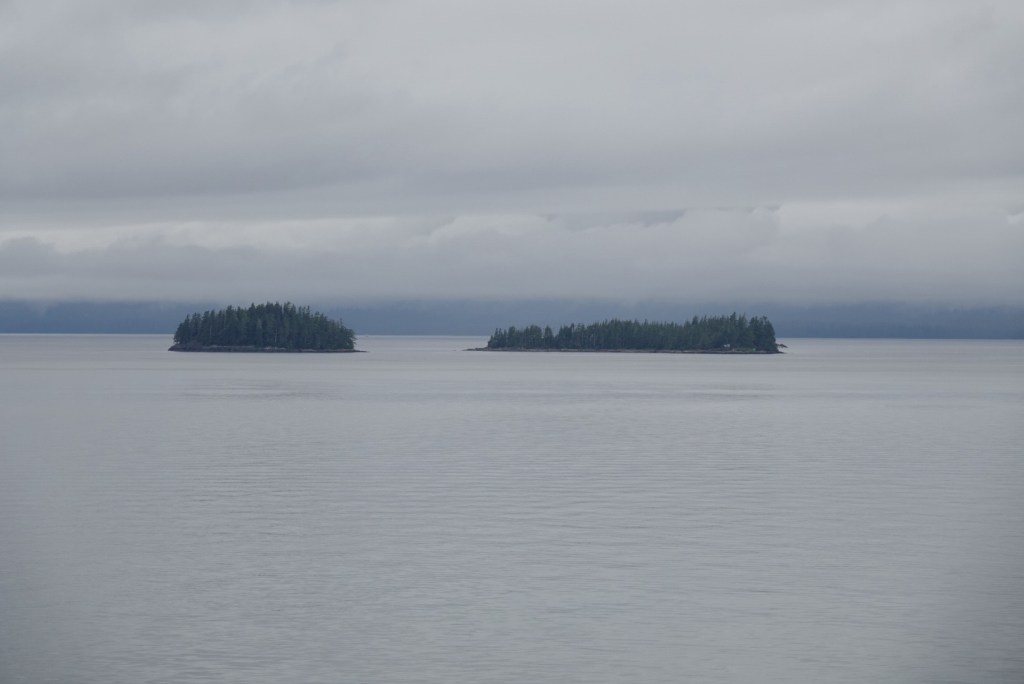
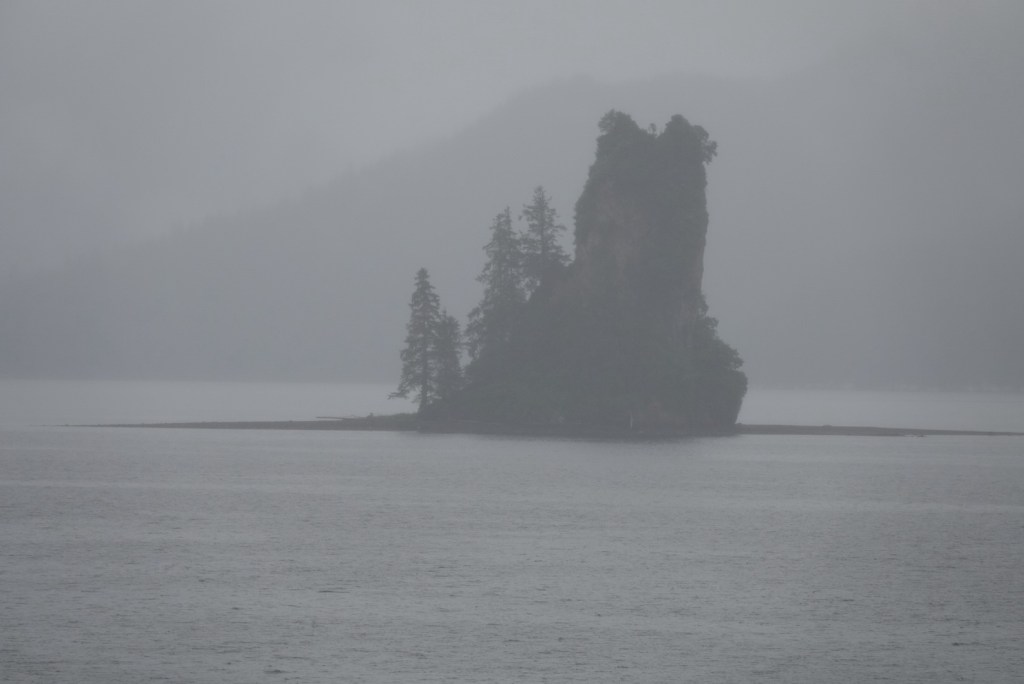
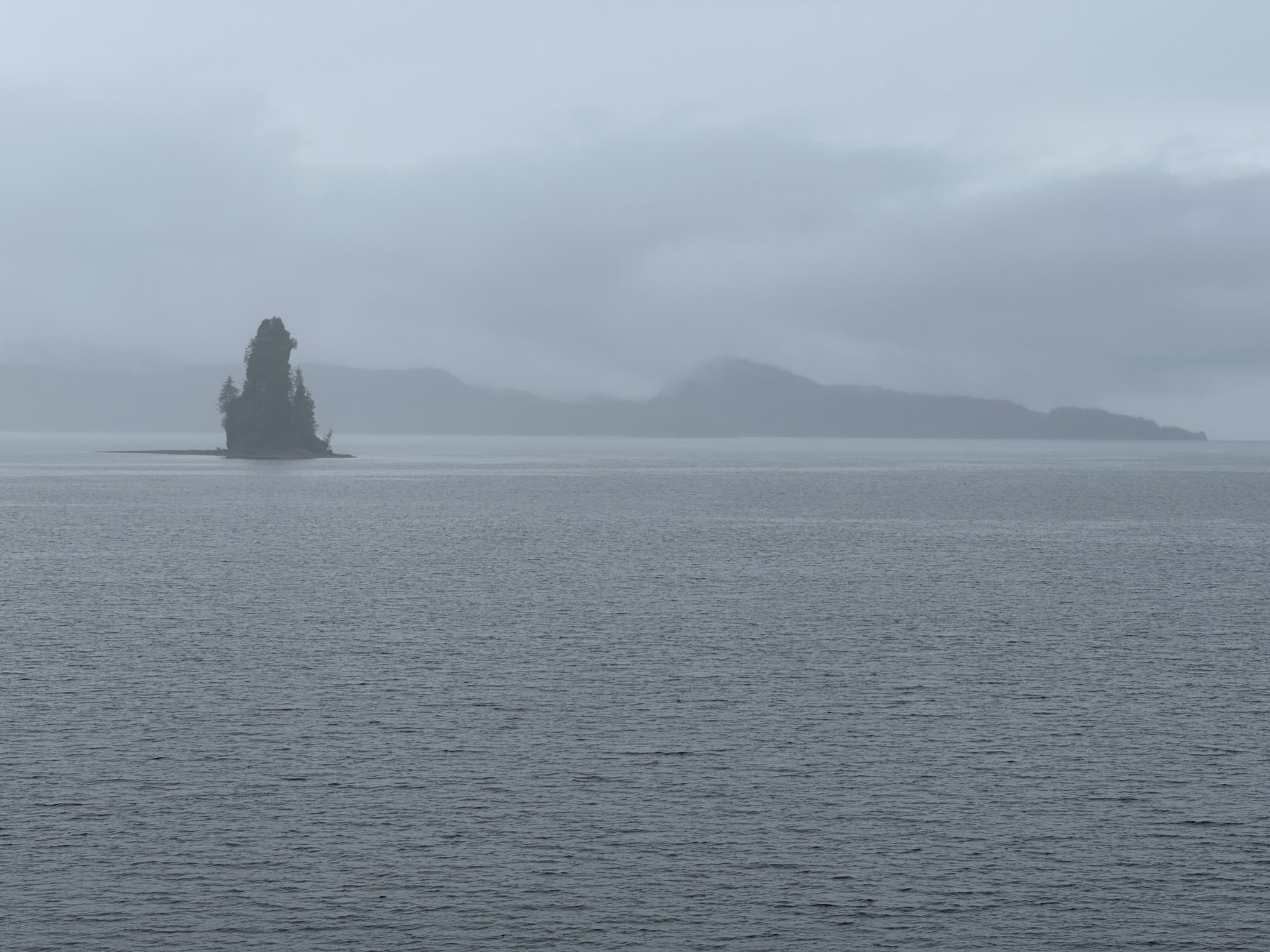
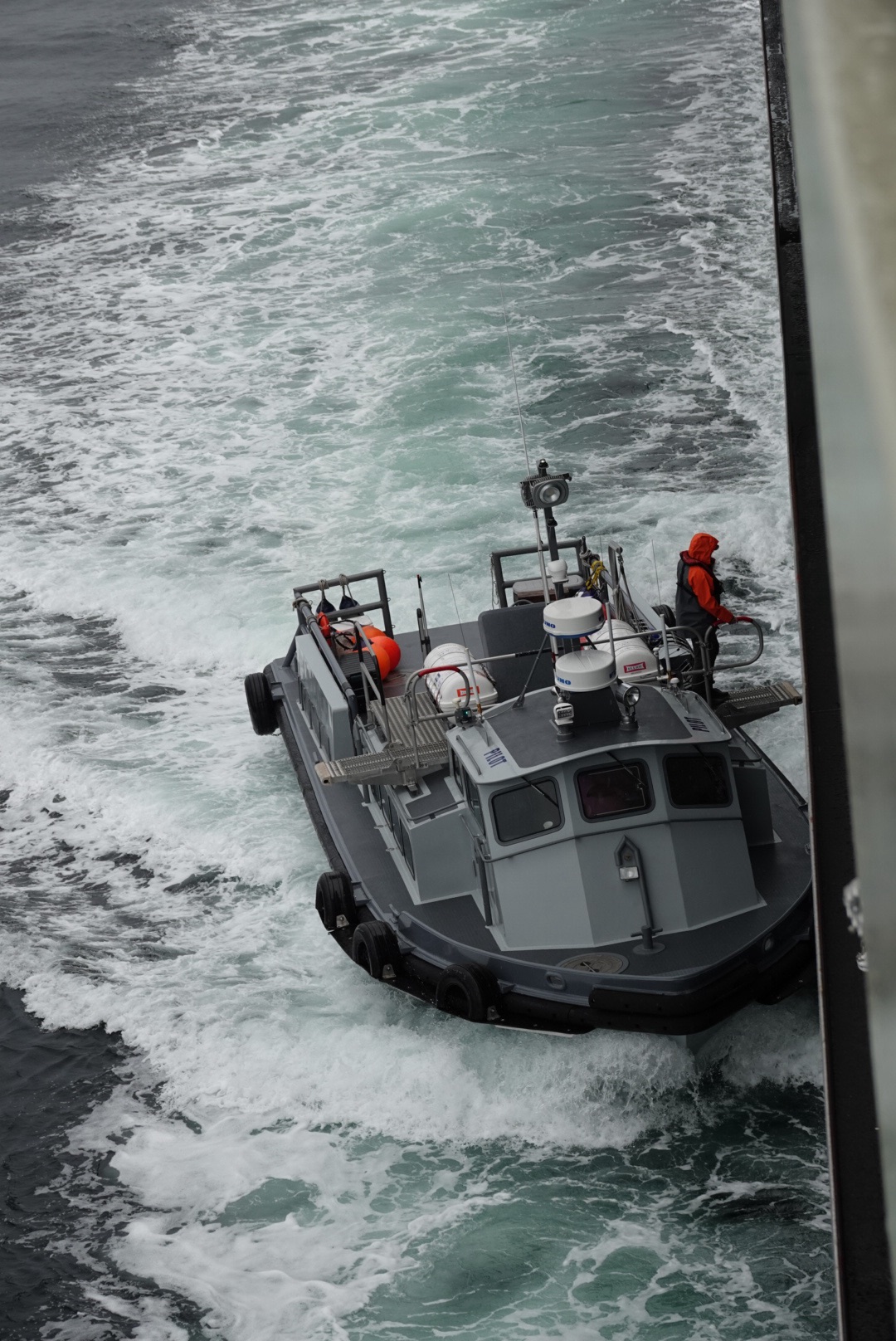
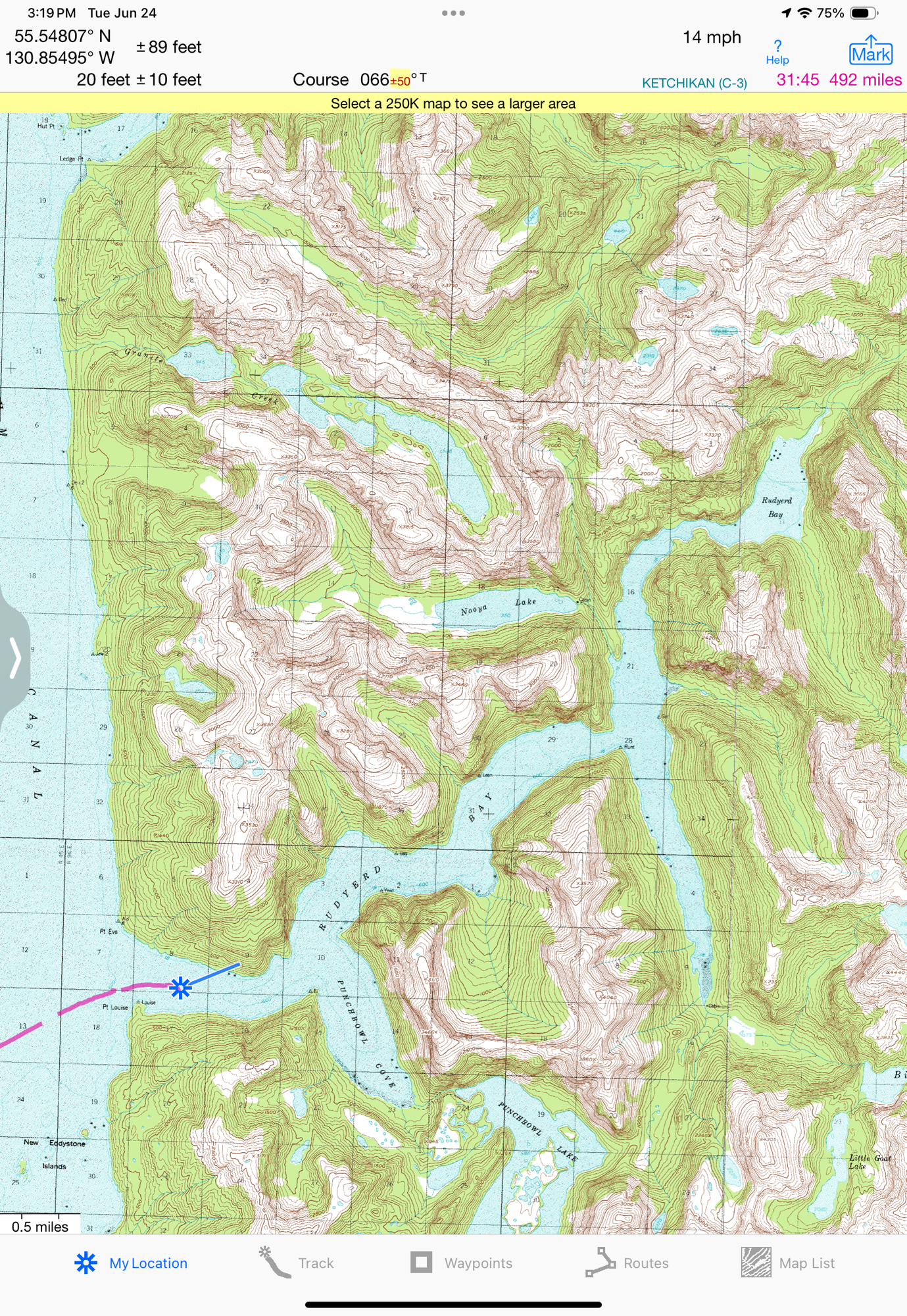
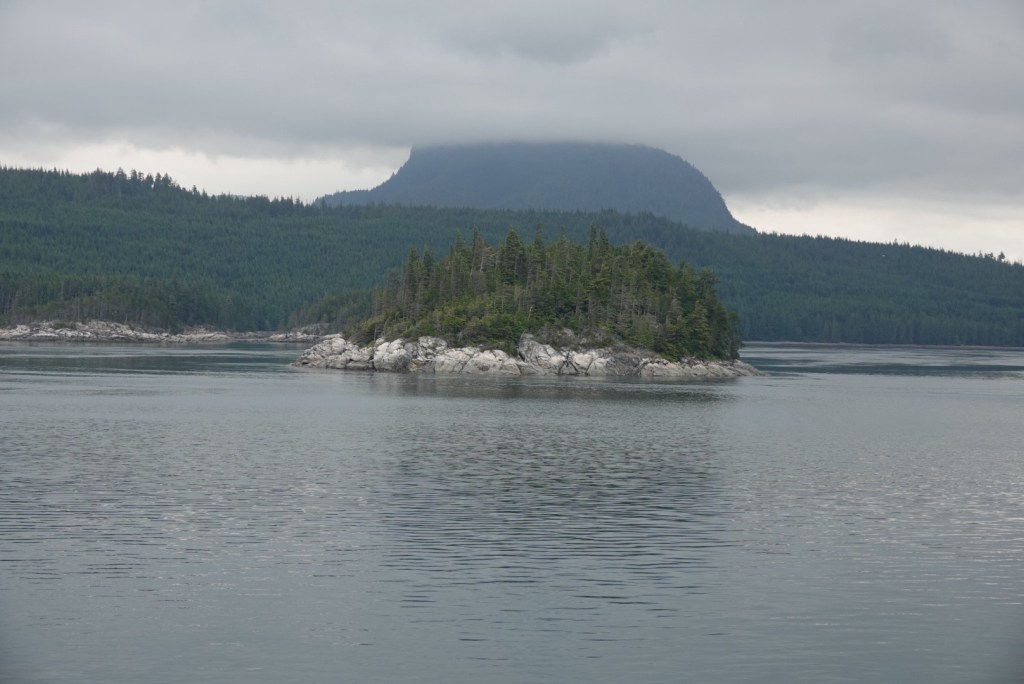
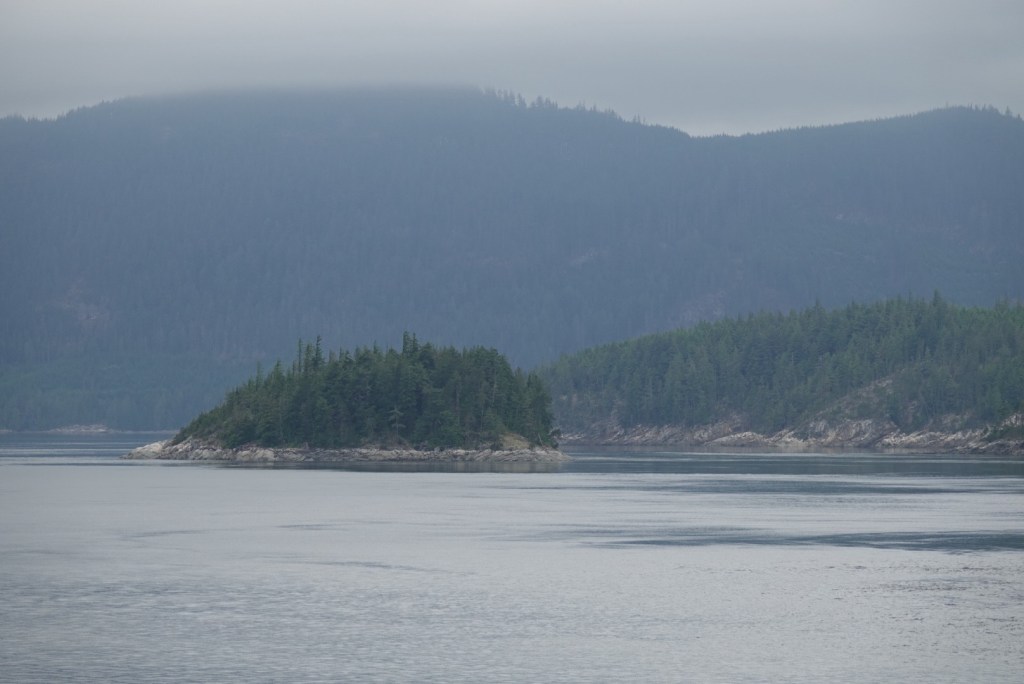
Dining area on the ship. We have to use our phones for schedules and menus.Island shapes reminiscent of Scotland’s Loch Ness in the inside passage? Does it have a monster, too?Ship superstructure. So many antennae!More islands with trees down to the waterlineNew Eddystone Rock, an igneous remnant from an ancient volcano. Another view of New Eddystone RockPilot boat transferring specialized personnel for negotiating the narrow fjords
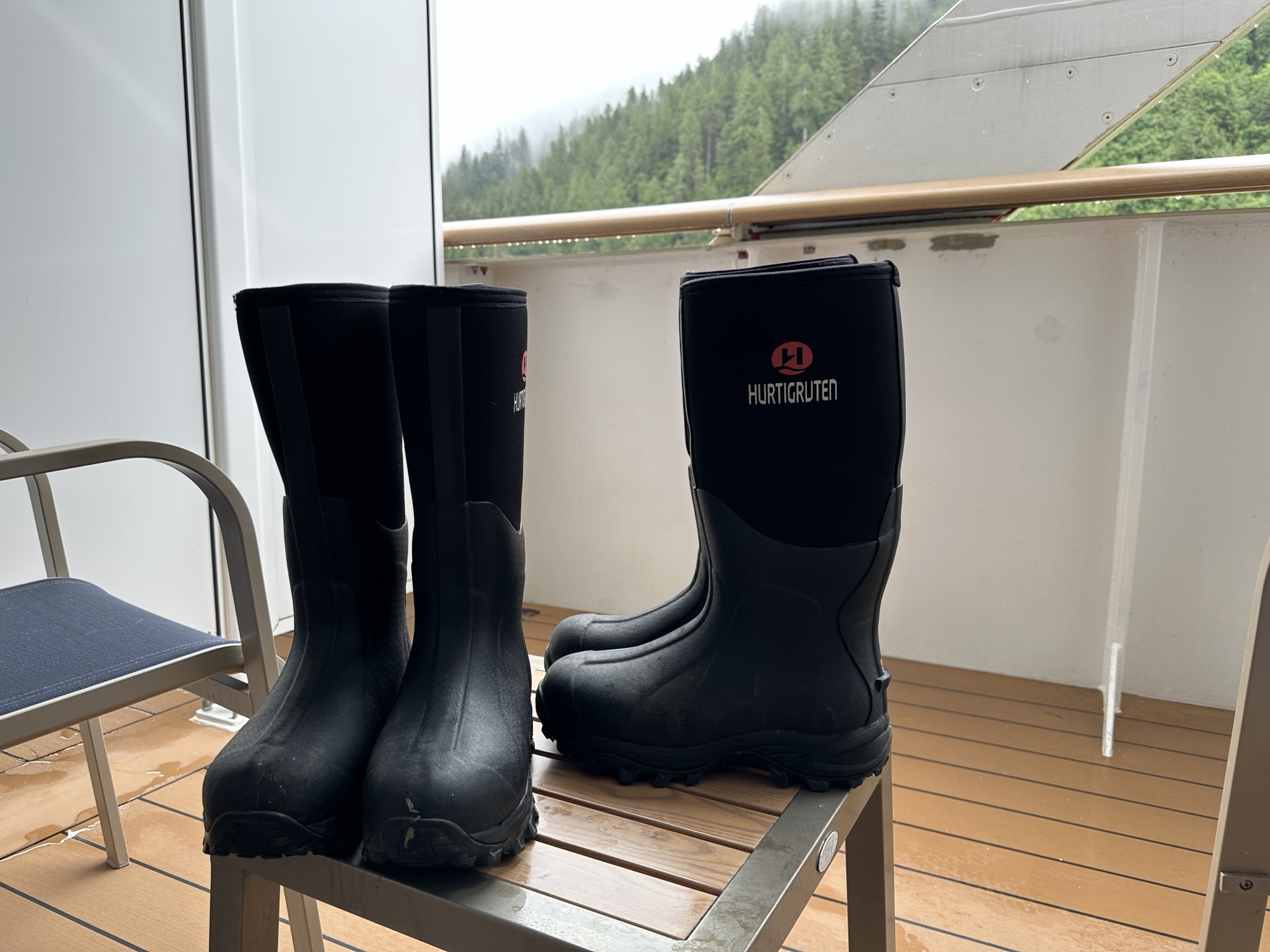
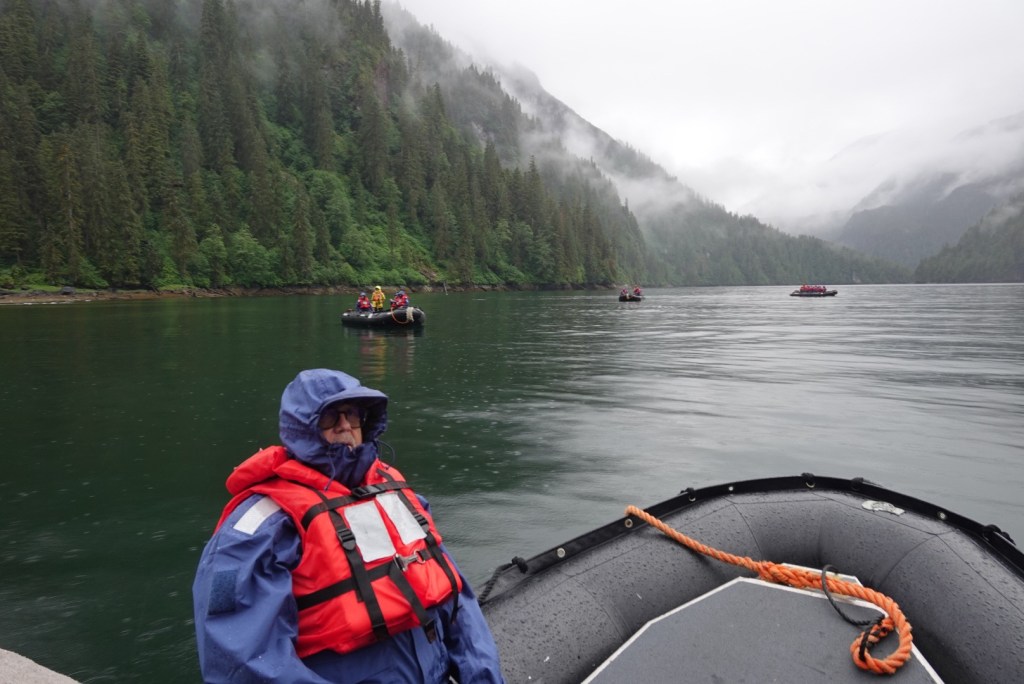
Yesterday, we were equipped with excursion jackets that we get to keep and mud boots, huge and heavy that we don’t want to keep. Both were necessary for our first Zodiac tour in the Misty Fjord!.
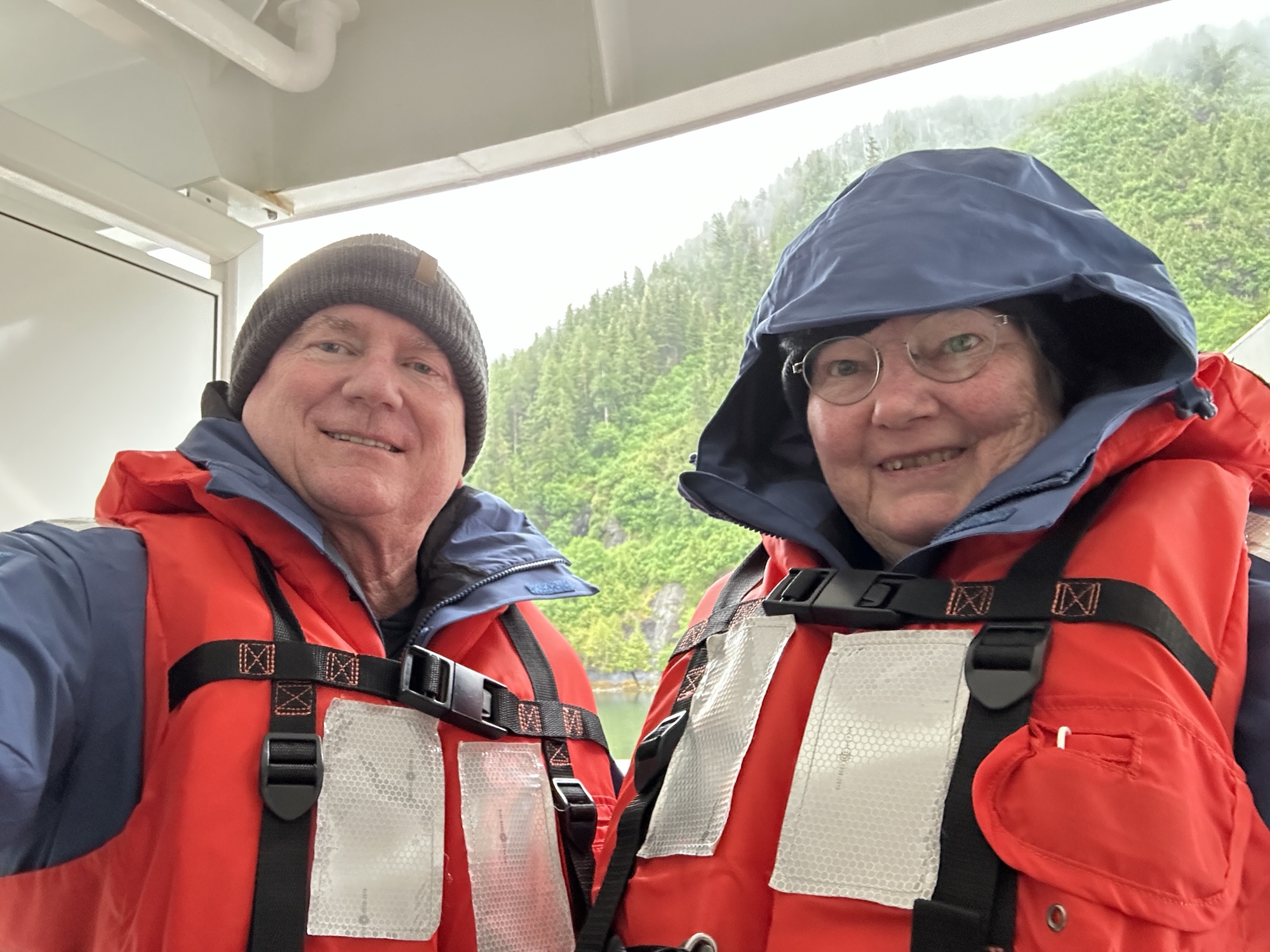
We were fitted for expedition coats and shoes yesterday, so we were ready for our first Zodiac tour.
Giant, heavy waterproof boots, great rain jackets, cumbersome life jackets and a map showing where we were going (the northeast end of the fjord).
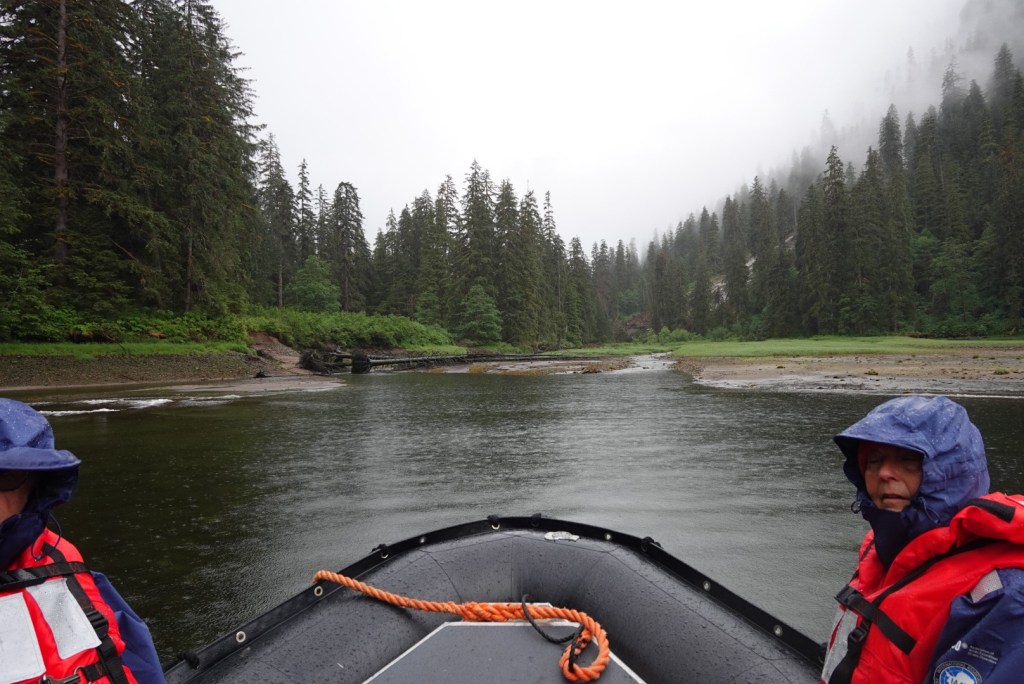
I didn’t really feel like I was in Alaska until we got into the Zodiacs and out onto the ocean. We rode very near the shorelines all over the area. The water was super clear near the shorelines; you could easily count the rocks below. The reason the ocean water in the fjords seems opaque is that they are so deep.
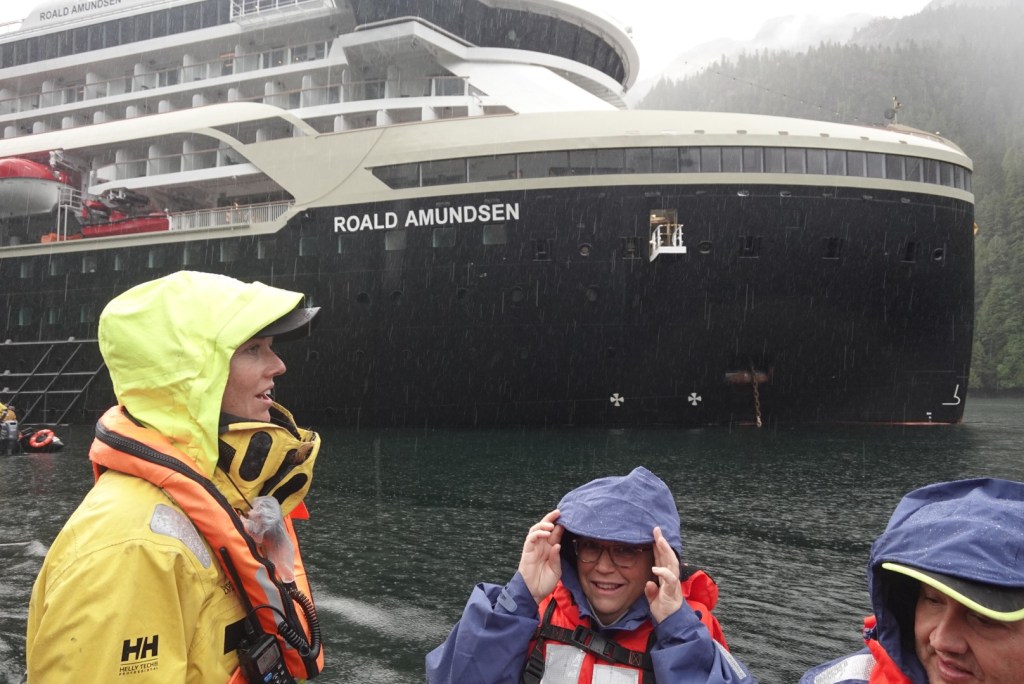
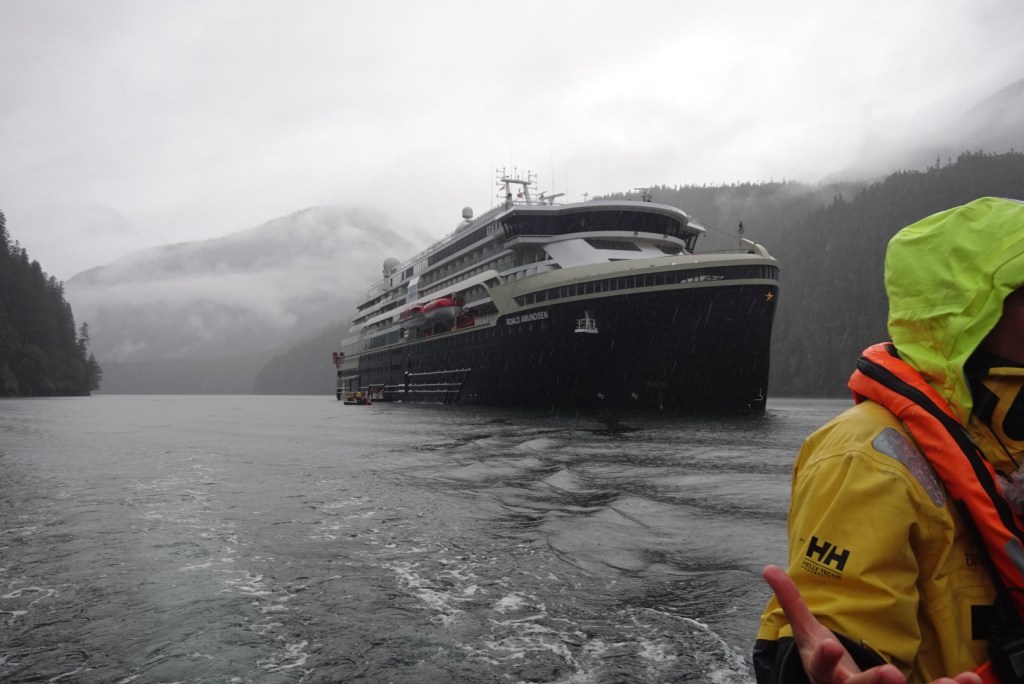
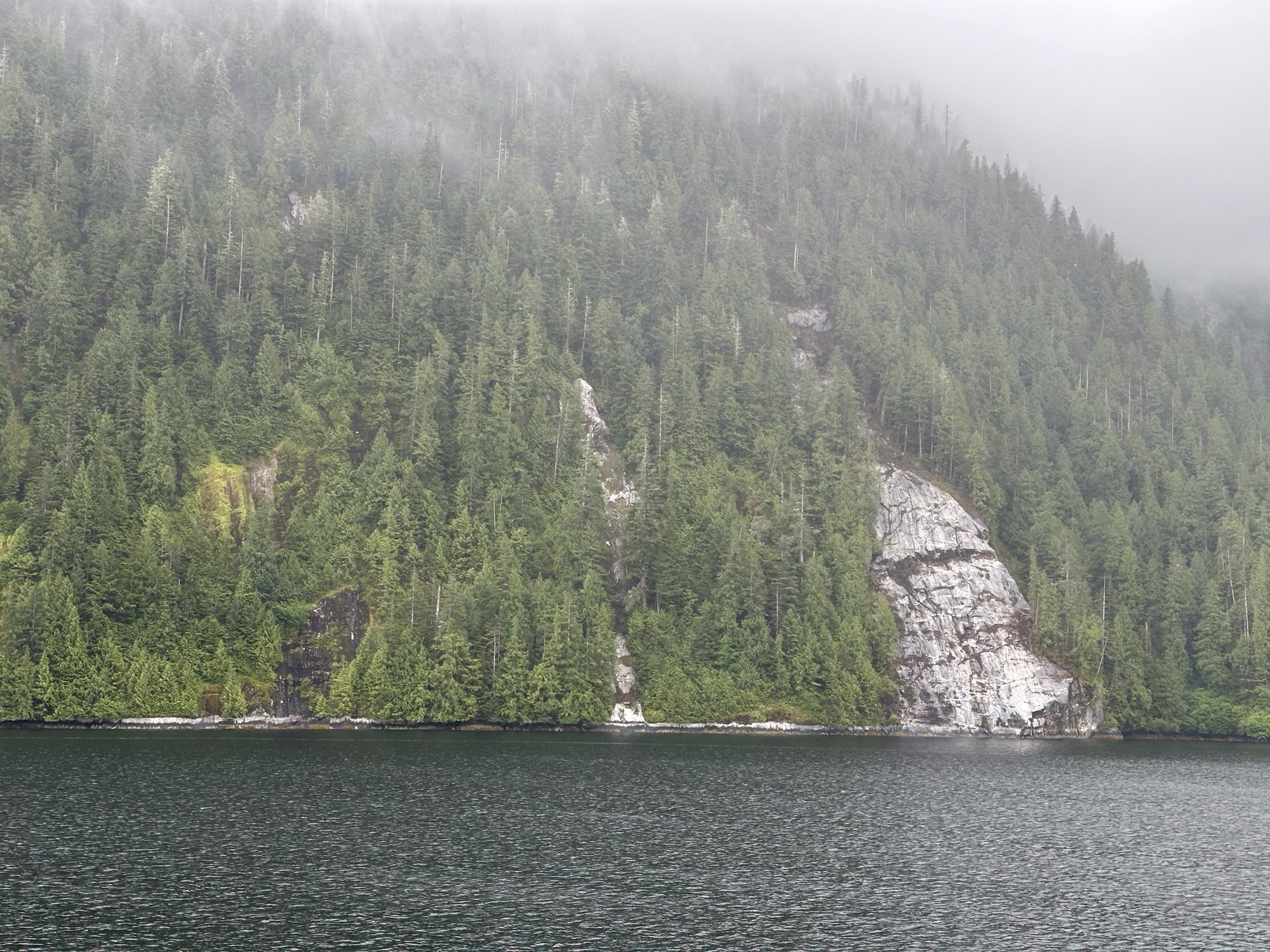
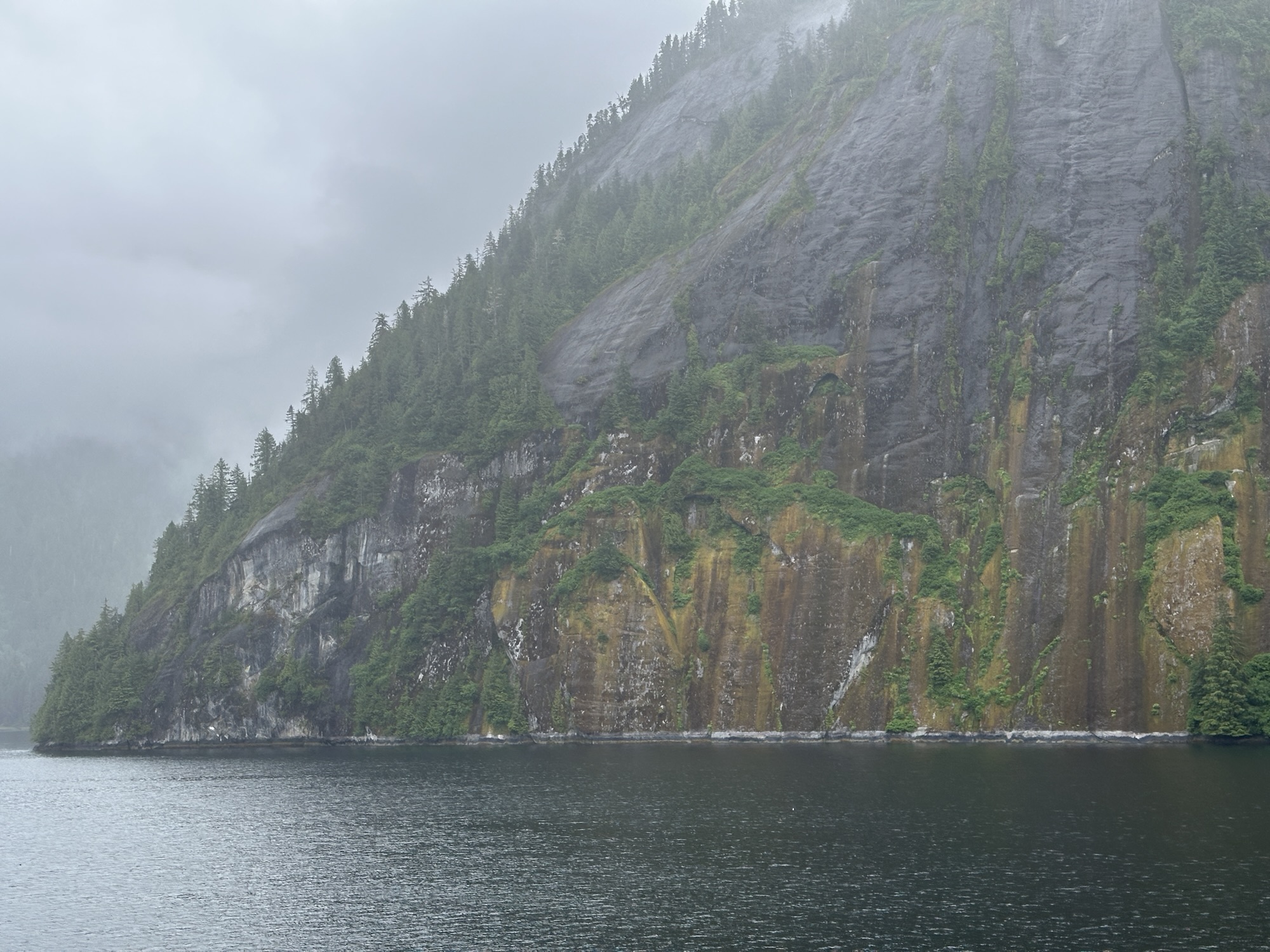
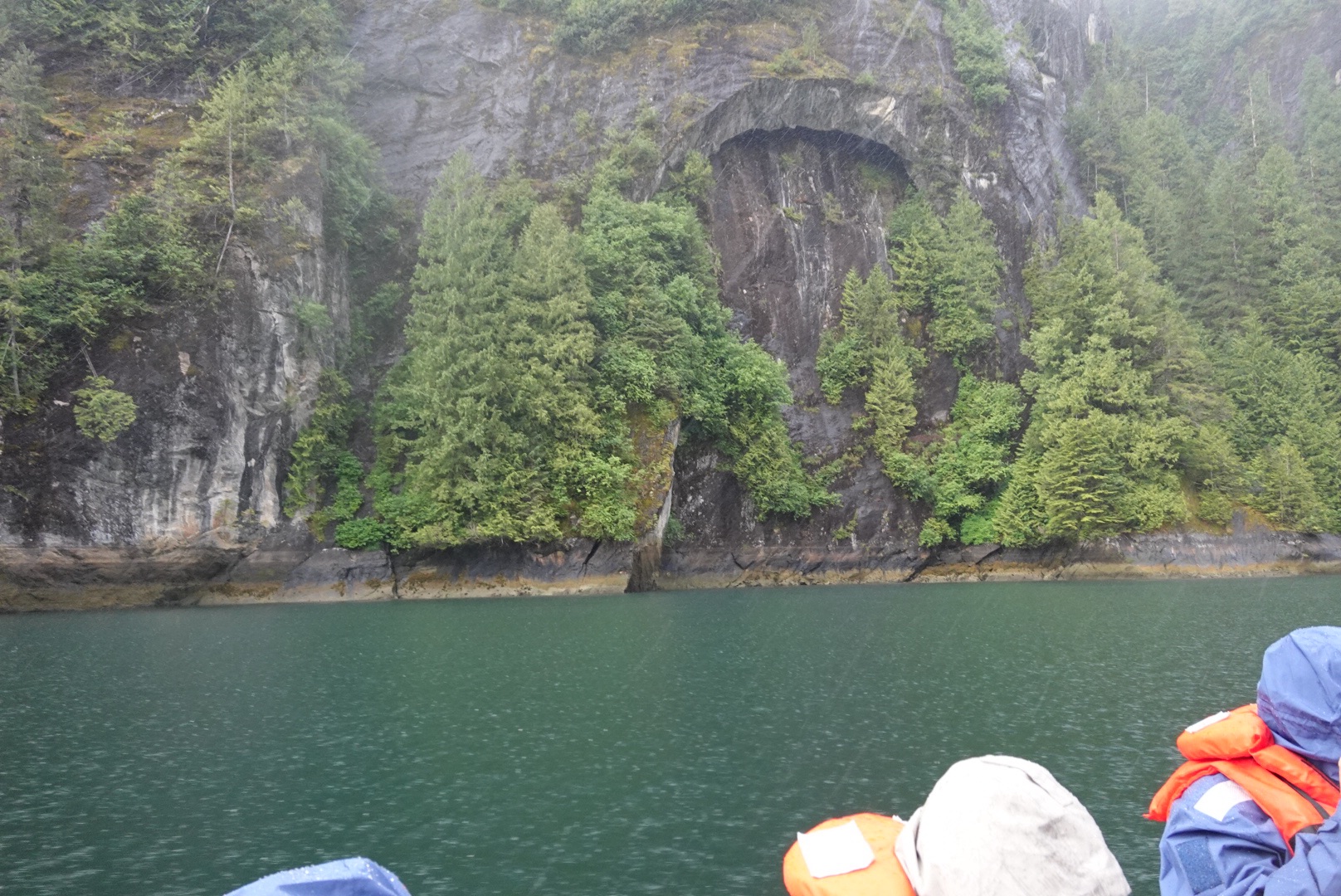
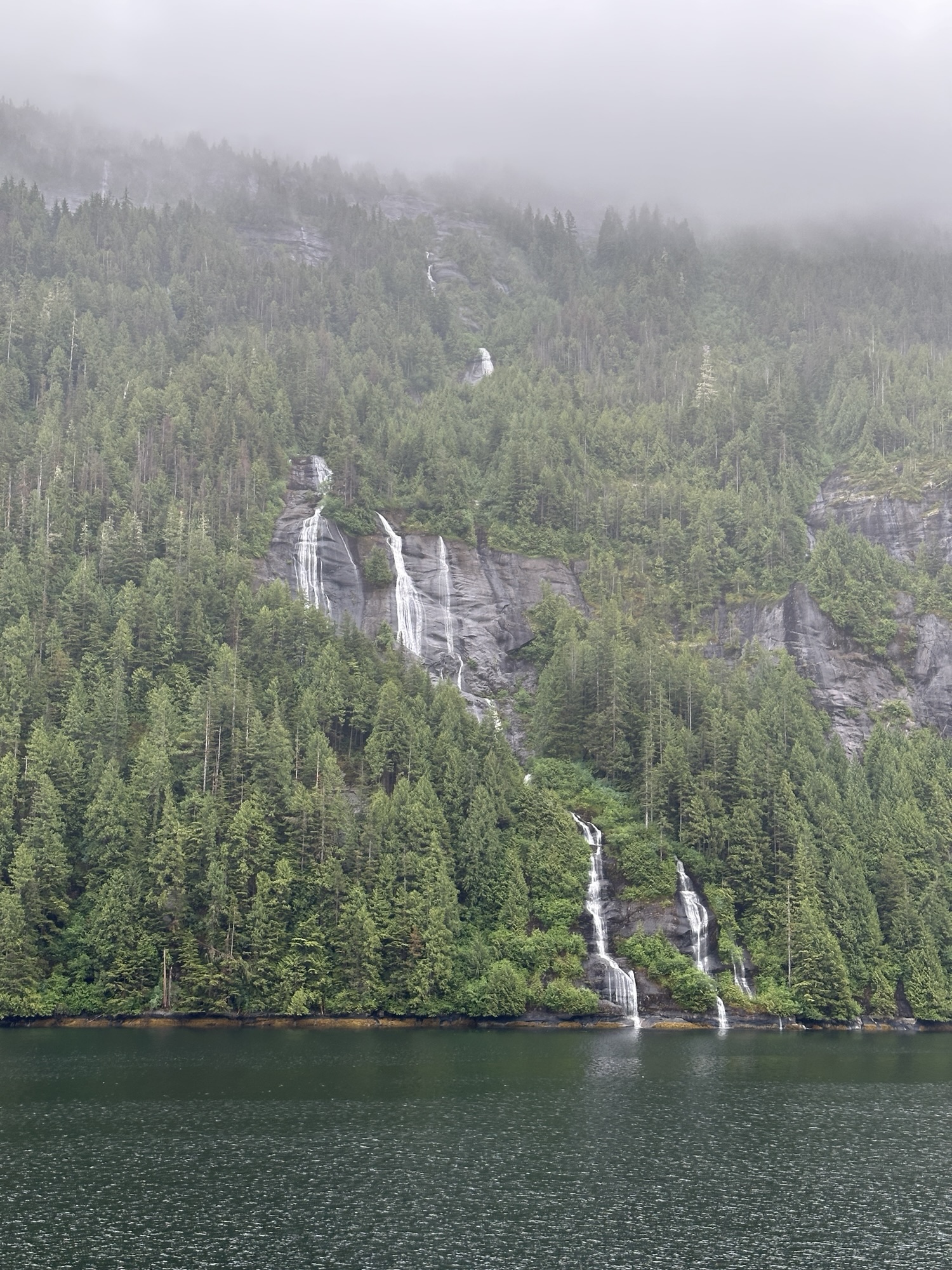
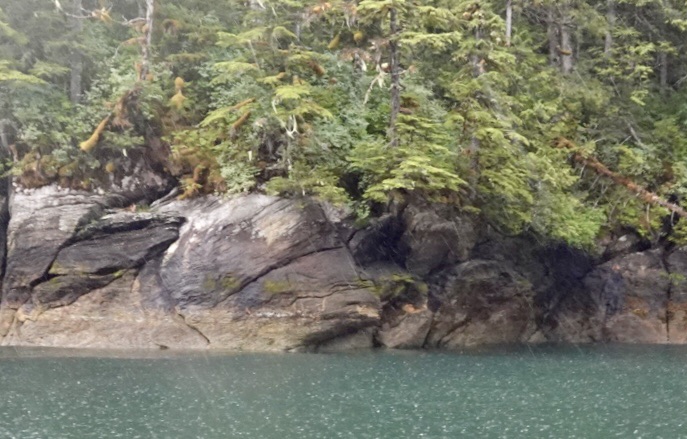
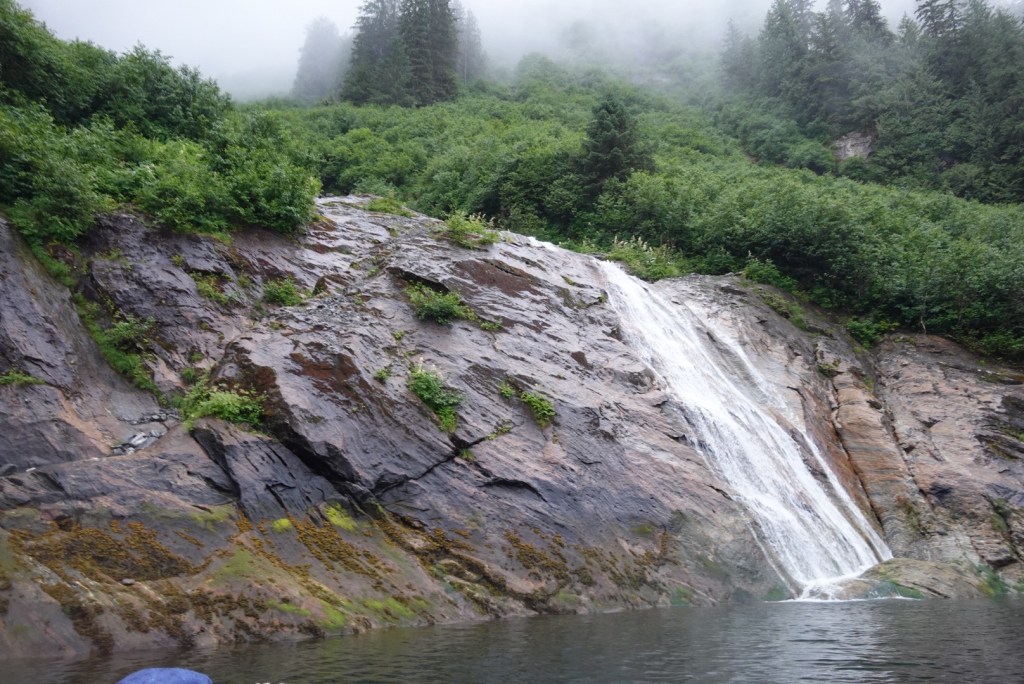
Misty Fjords National Monument is aptly named. These are views from our rainy Zodiac trip.
A Zodiac boat leaving the ship before ours.Our guide, Lauren, in yellow. Our ship as we started our adventure. Other Zodiacs touring the Misty Fjord as Clare enjoys the rain.The sedge at the end of the fjord, where a stream is flowing in at low tide.Shear rock cliffs between the trees show how thin the soils are over the glacially scoured land. The white line above the water line is called the dead zone, where land plants and ocean life cannot survive.Exfoliating rock forming a proto-arch, may become a dome later.Water falling down the cliff on the side of the fjord.We saw three harbor seals, on the rocks, not very visible here. Rain makes photography difficult. Cascade over gneiss. A closeup of the rock would show intricate folds.
Sound of water falling!
Tongass National Forest has, from two of our guides presentations, one third of the old growth rainforests in the world. They of course want to preserve this pristine environment, and politely pointed out problems from current administration policies. No names mentioned.
Sorry this was not sent yesterday. Our excursion was late in the afternoon, the internet connection is spotty, and we were tired.
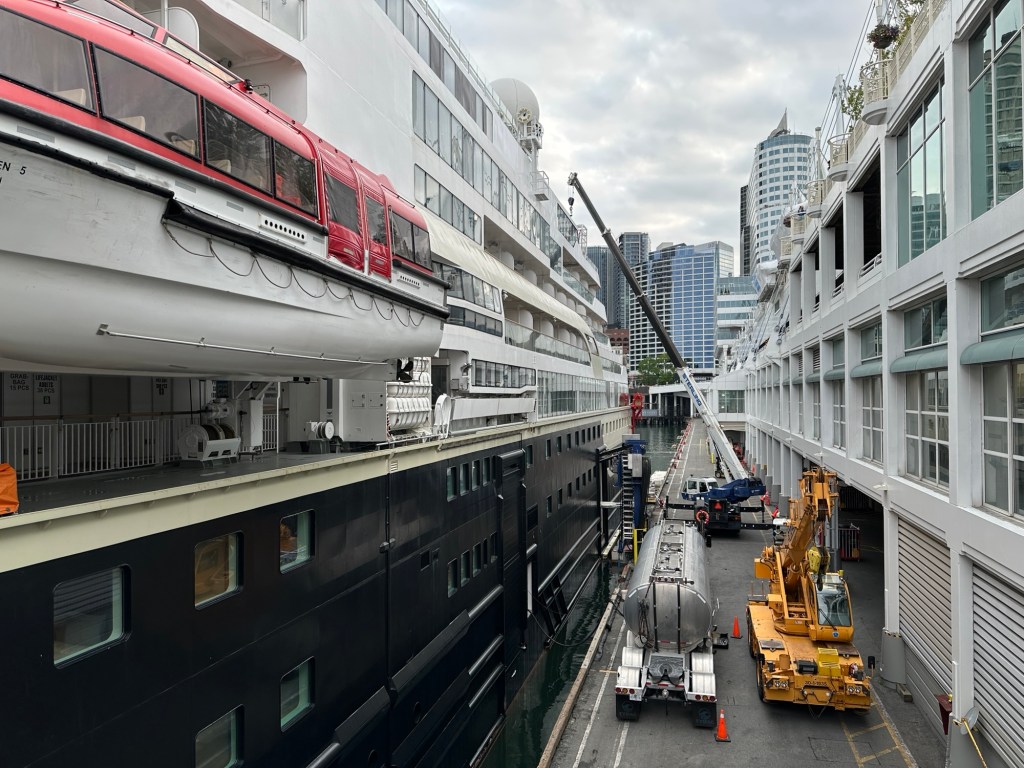
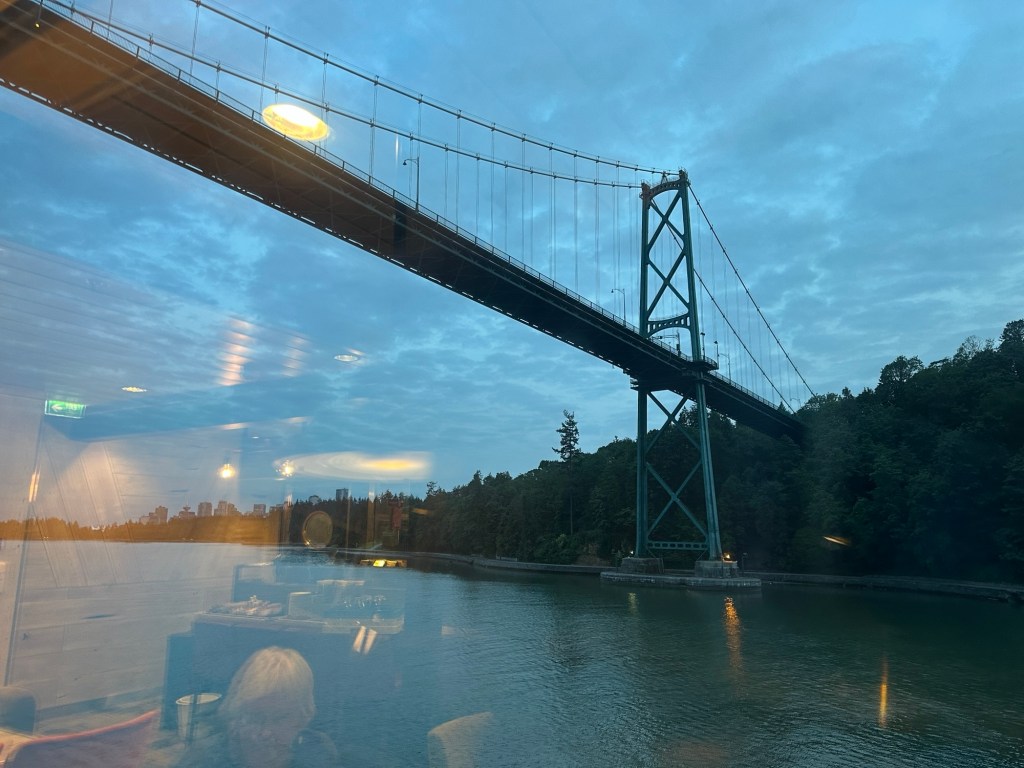
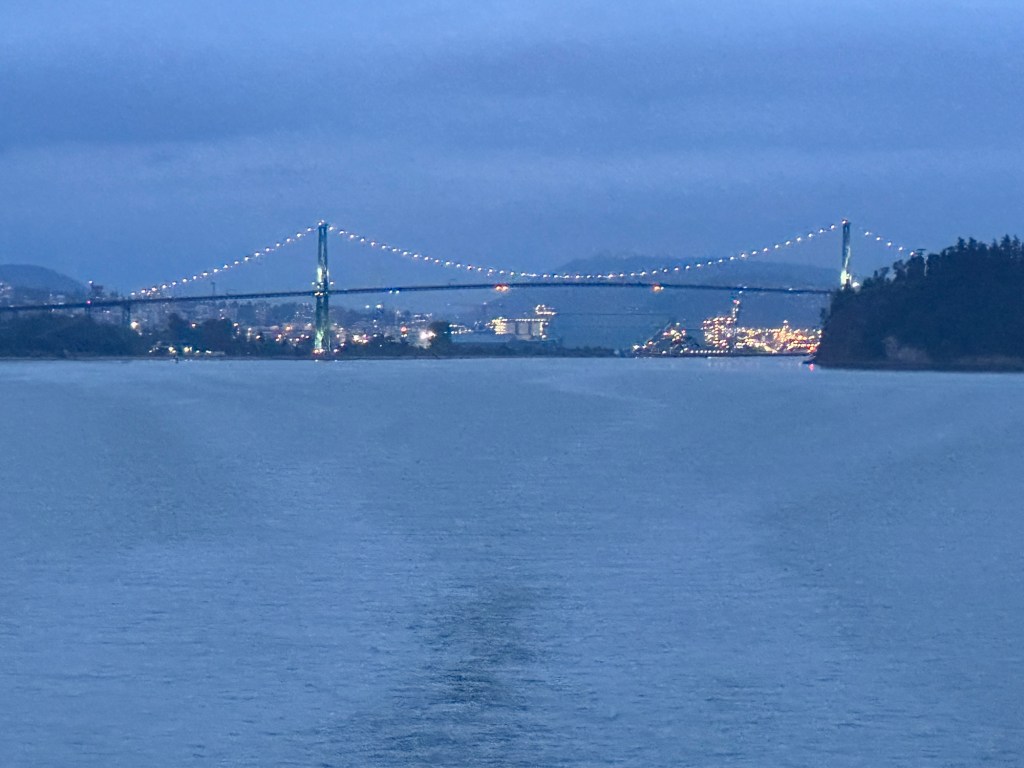
The ship loading fuel and luggage in Vancouver During dinner, we sailed under the Lions Gate BridgeLions Gate Bridge at night
After Vancouver, we start out with a full day on the ship, learning the ropes, so to speak (which deck has food and which has observation areas etc.). The ship went through the Inside Passage (not well defined geographically), starting in the southern part as a wide seaway then narrowing so we could see land on both sides.
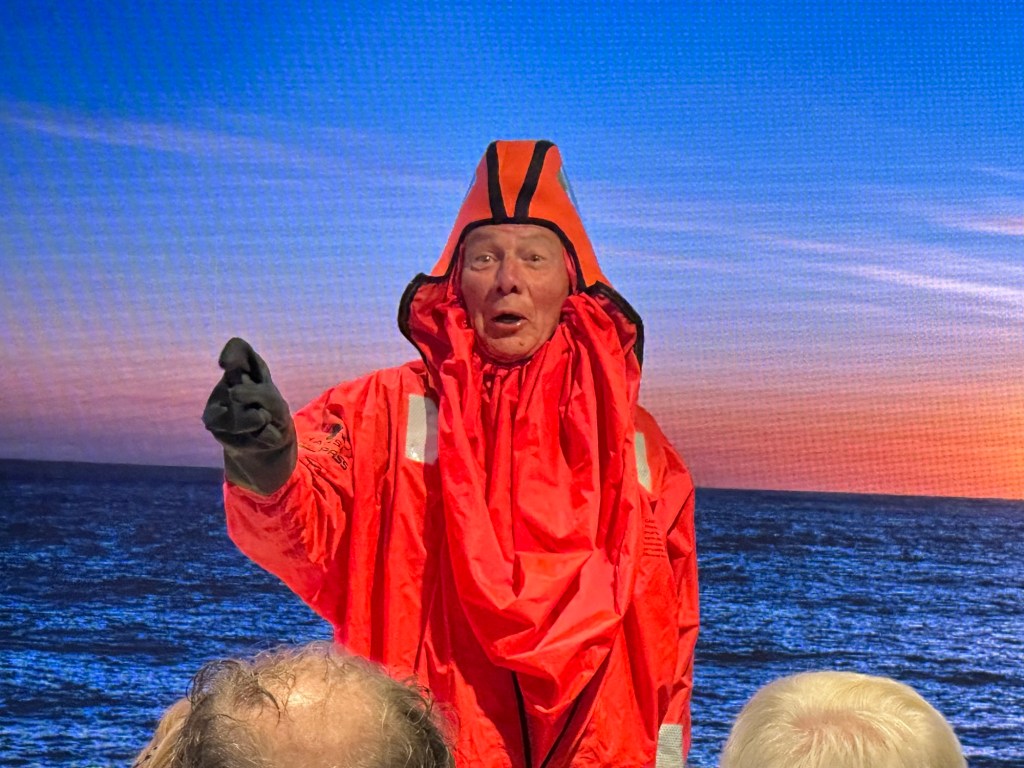
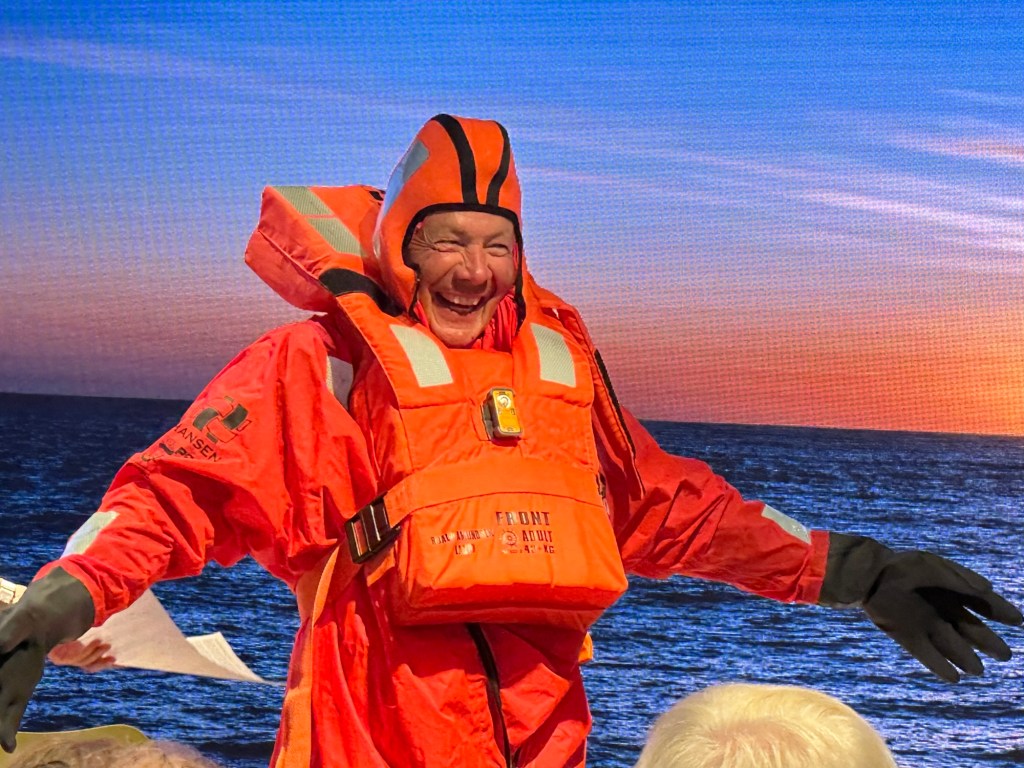
A demonstration about emergency safety procedures was made humorous by a guy named David who obviously felt a bit silly in the rescue suit. We hope we won’t need to learn more about that!
Crew member David demoing the rescue gear that we hope to not need!
Clare was a bit hyper, wanting to see everything at once, figuring out good viewing points from the ship, so she was outside when the first spouts from two Orcas were sighted. Unfortunately, no binoculars or camera, but the double spouts were impressive.
Once we could see land on both sides, the changes in green colors were interesting. We finally realized that the paler greens are young trees, growing out of clear cut areas in the forest, darker greens are older trees. Beautiful greens everywhere, with tiny villages set into valleys.
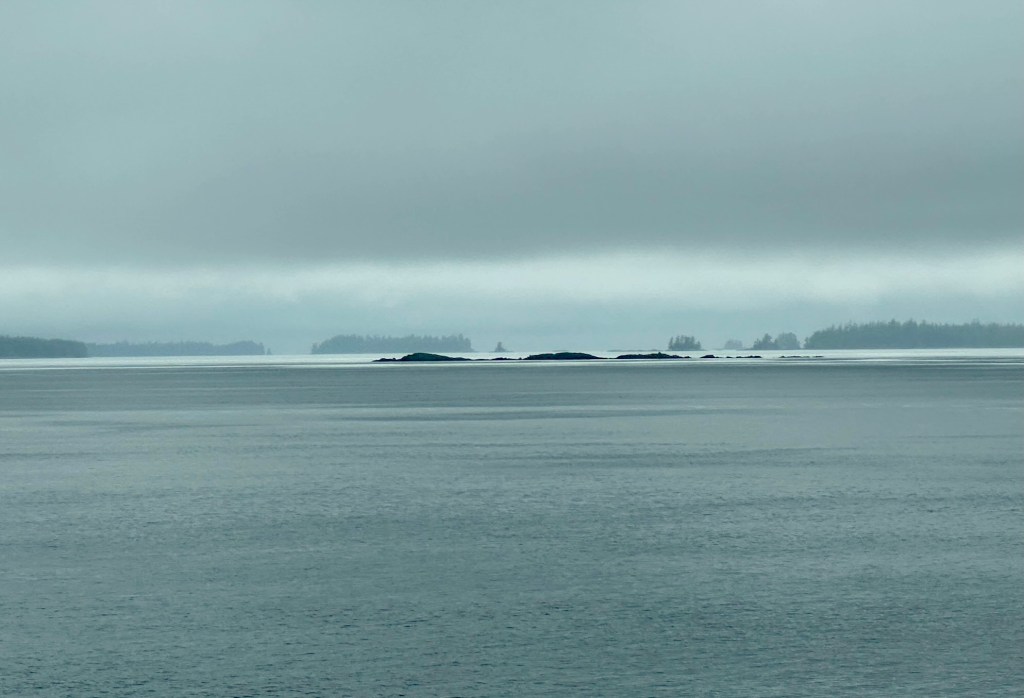
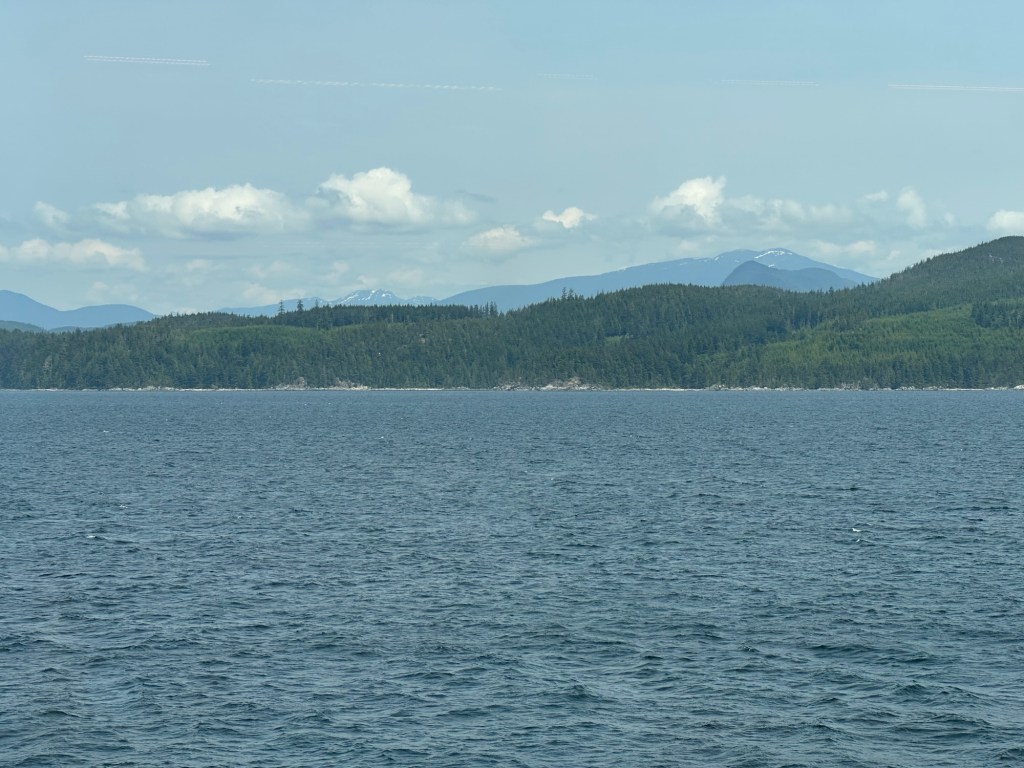
The landscape is fascinating! Tiny steep-sided tree-covered islands,with narrow water passages. Sometimes we can see up to three mountain ranges toward mainland British Columbia, the highest peaks capped with snow.
Many islands!
The ocean showed varying colors, ranging from pale blue where no wind disturbed the surface to deep green or black closer to the ship. The water is about 1,000 feet deep here in the narrower part of the passage. With breezes, small white caps appear and disappear, making us want to pretend that a large group of seals are playing nearby. But no.
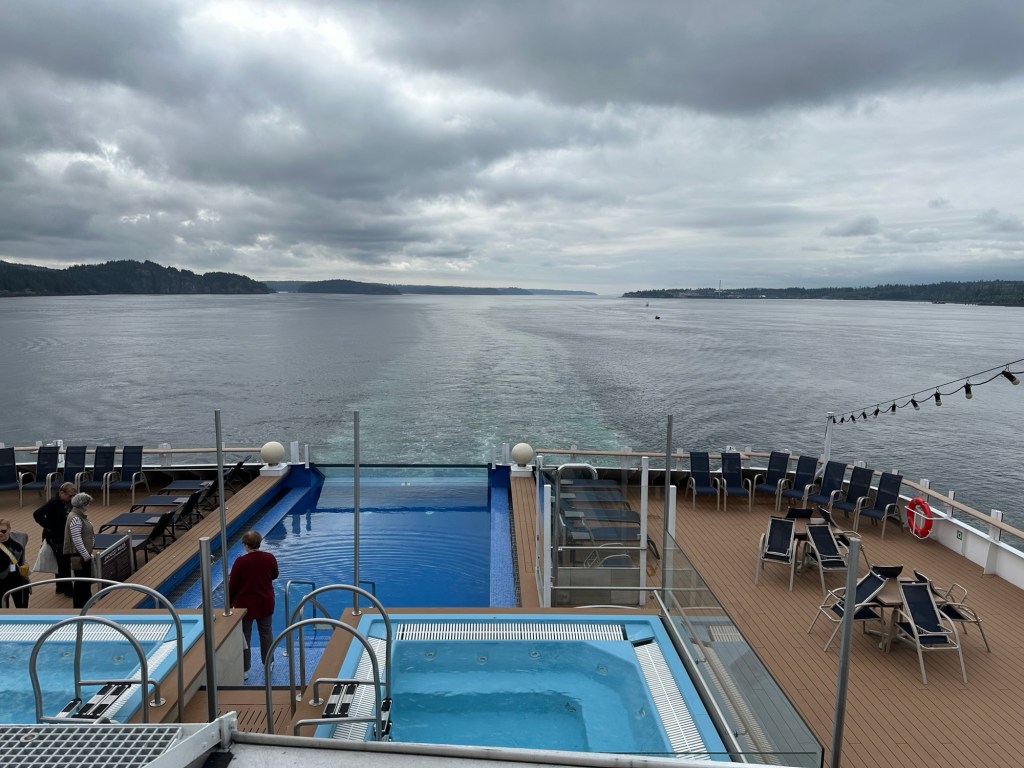
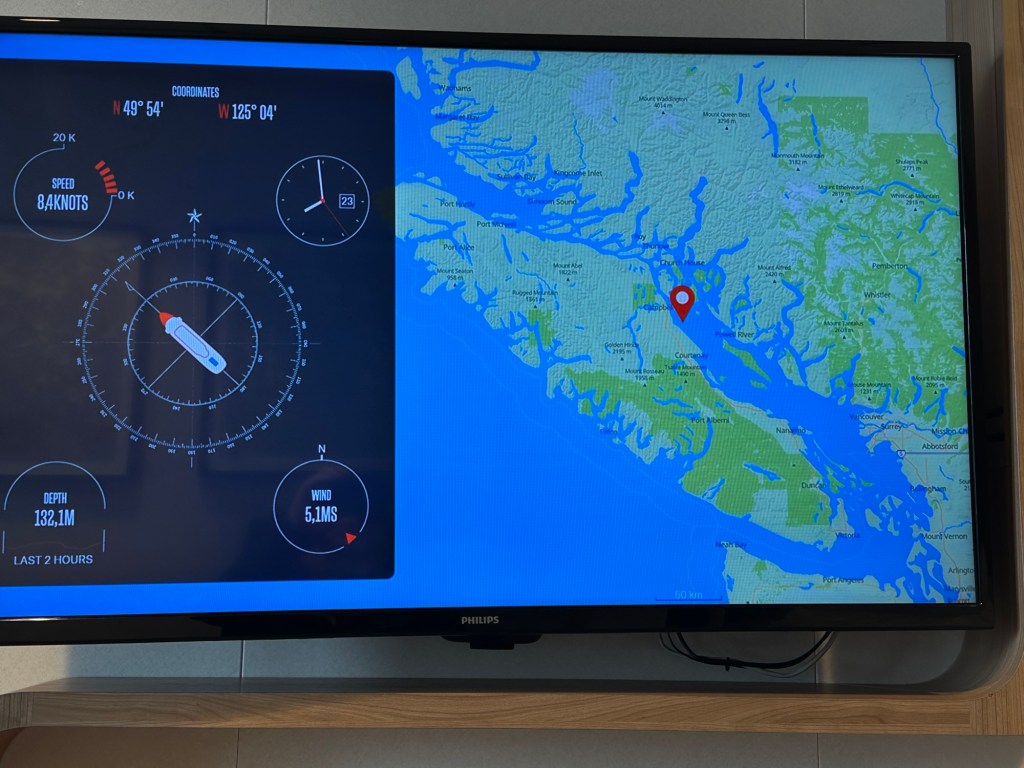
Hot tubs and infinity pool at the sternTV channel shows current ship info in our room (and on large screens elsewhere)
The ship is small enough to easily find your way around after a few exploratory walks. Lots of stairs, but there are elevators too. With only 300 guests on board, very few events seem crowded. We have been assigned to the “Sea Otter” group for assembling for excursions to avoid crowding the departure deck (level 3). Our cabin is on deck 7, starboard side. In the sheltered sea of the inside passage, the sailing is so smooth that you can hardly tell it is moving; speeds range from 10 to 15 knots most of the time.
The passengers are from all over the globe. We have observed folks from Germany, France, Switzerland, China, New Zealand, and the US. Tonight at dinner we were seated next to a couple from Montrose, Colorado! The only official languages on the ship are English and German, but if you want to go kayaking you must know rudimentary English, a maritime law requirement.
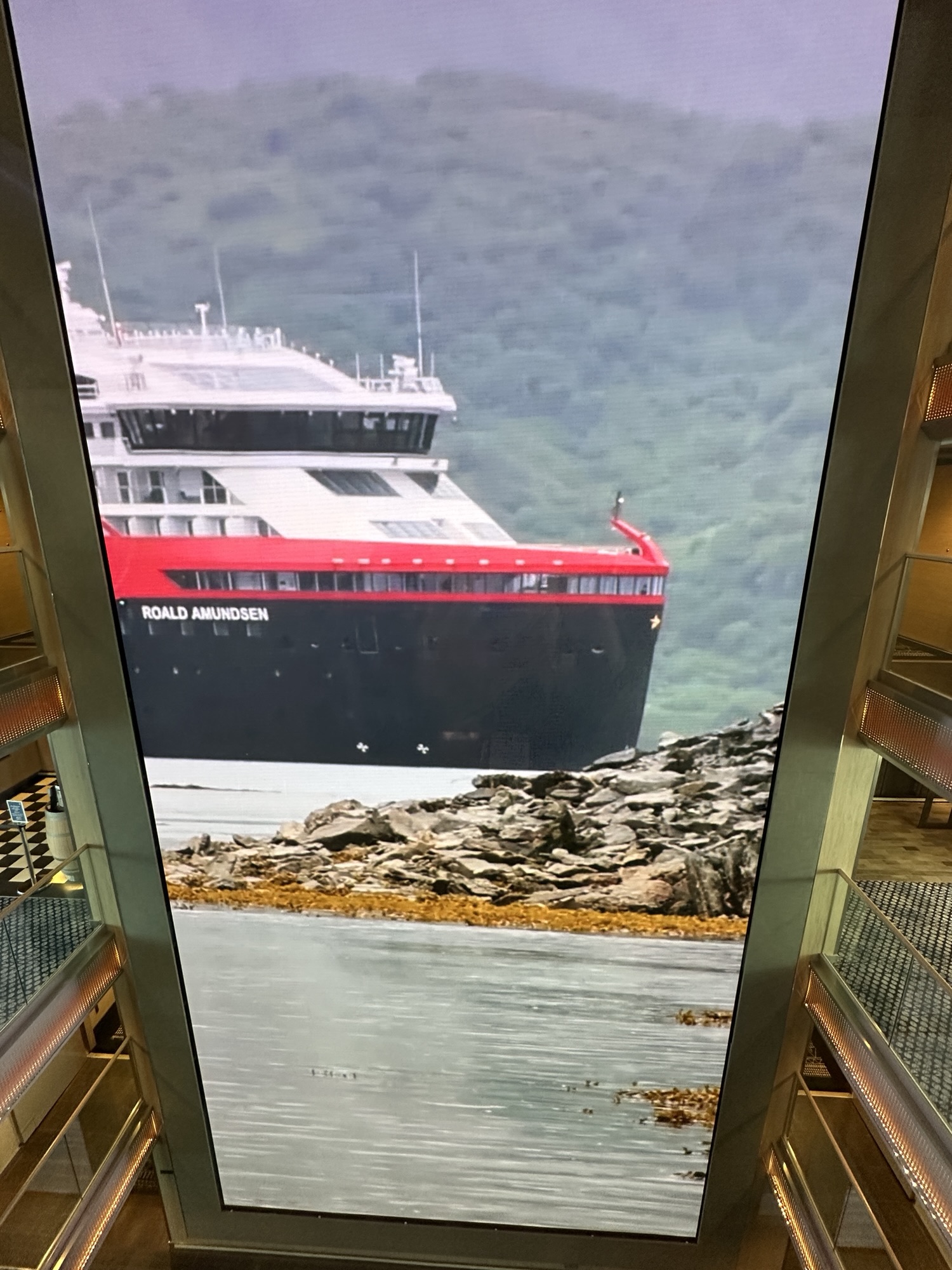
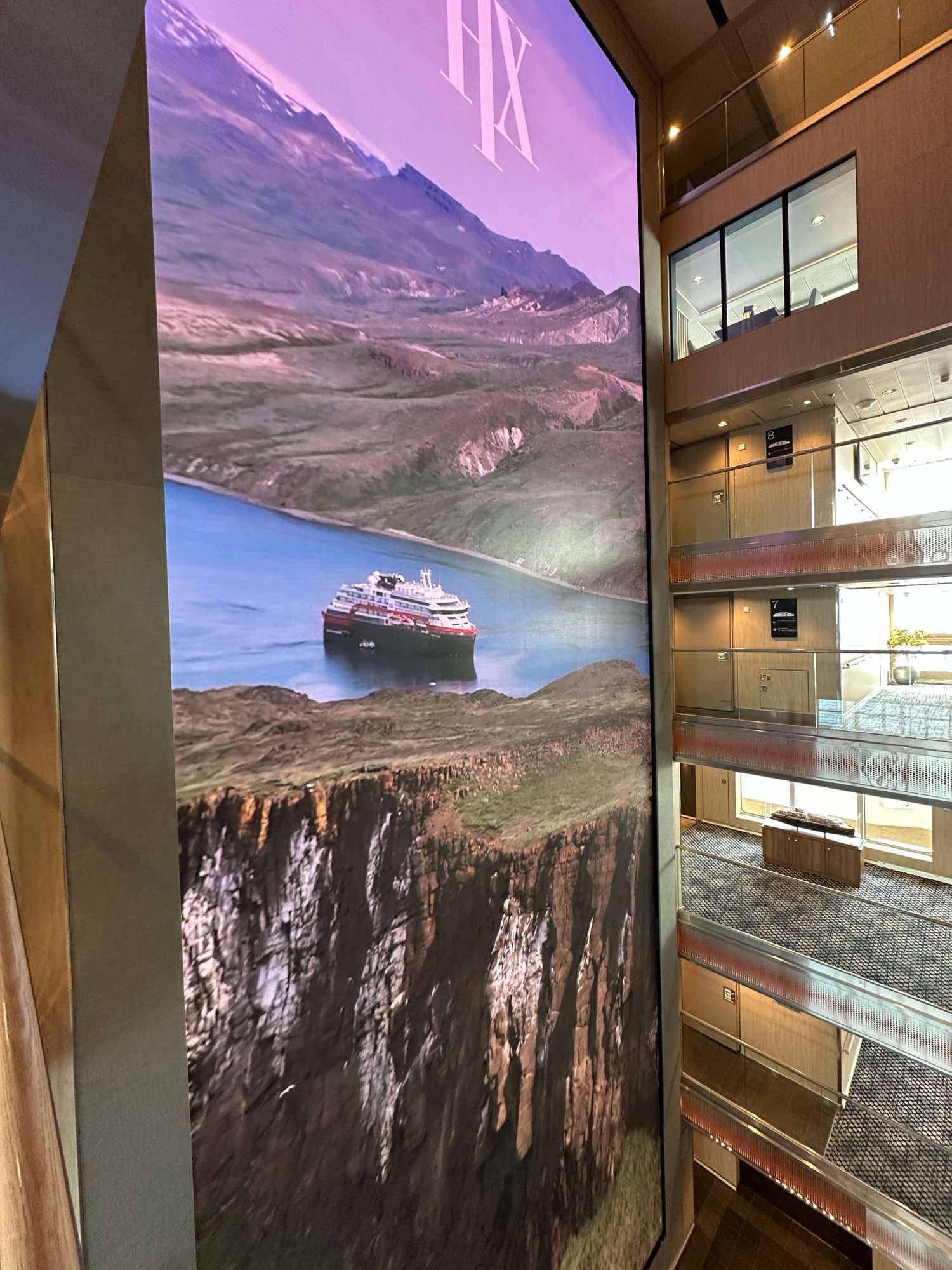
Adjacent to the main elevators is a huge screen showing images and videos from previous expeditions on Hurtigruten. The screen is many decks tall as you can see. Impressive!
That is all for the first full day; tomorrow we will explore an area in Alaska by small boat.
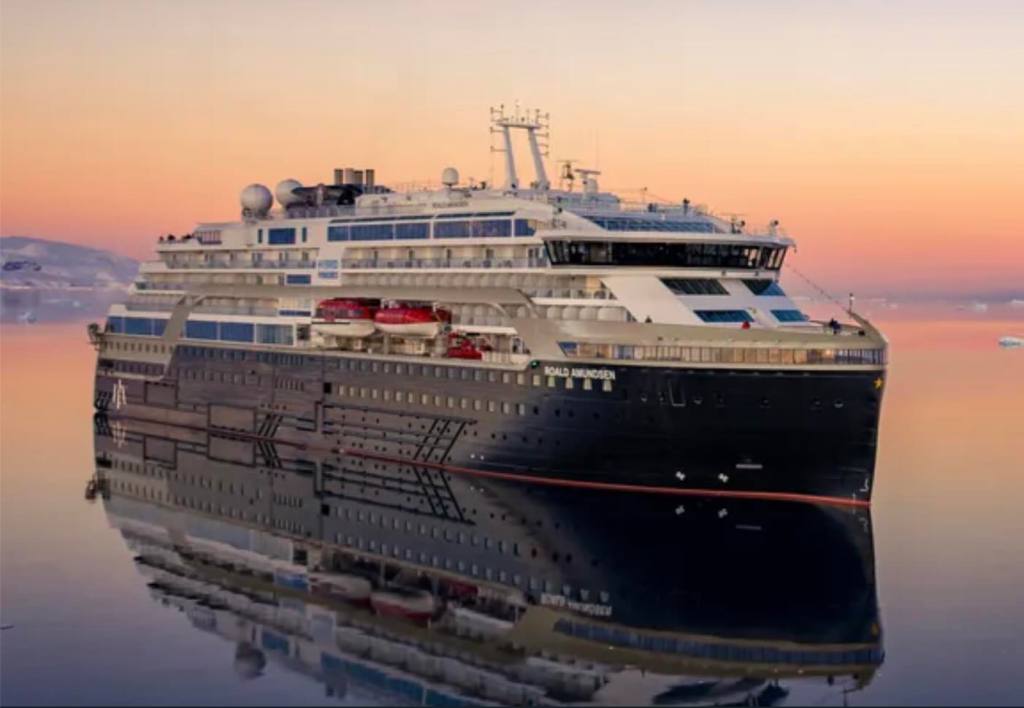
In a week or so we will leave for Alaska on a medium-size ship named for Roald Amundsen, the Norwegian explorer. This is the ship:
Our cabin is on Deck 7 (of 9 total).
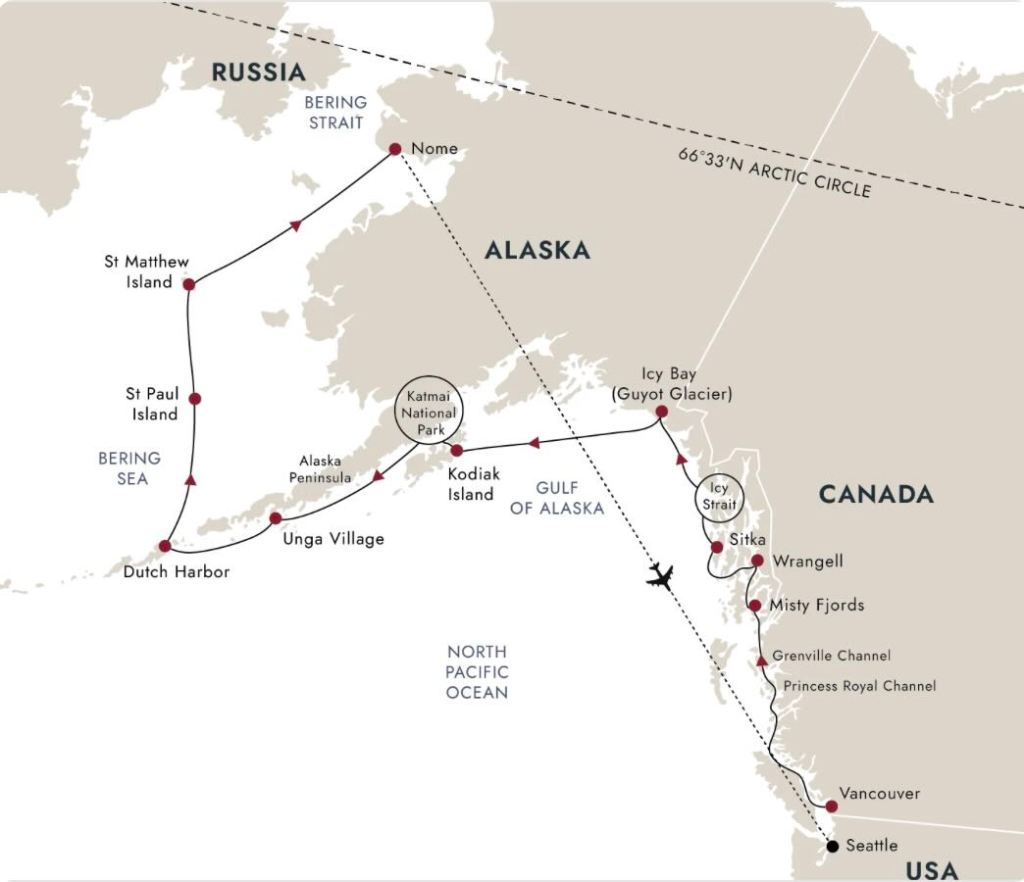
The itinerary spans 17 days, but we are adding additional time in Vancouver at the beginning and time in Seattle at the end. Here is a map of of the cruise:
We will have opportunities for boating, hiking, and historic tours. It should be quite the adventure!
 Bunch of Geeks go Traveling