Highlands Day 3, sleep in Tongue

I was too tired to write last night. I was asleep before Brian came back to the room! Embarrassing, that, but the truth due to the fact that I have not been exercising enough at home.

Yesterday was a day looking at and climbing to faults. There are minor folds associated with the faulting. Our first stop (Kempie) was to look at where the idea of thrust faults came to the geologists of the 1800’s. We hiked upwards through heather to view an asymmetrical syncline, a large fold that is vertical on one side and slightly dipping on the other.
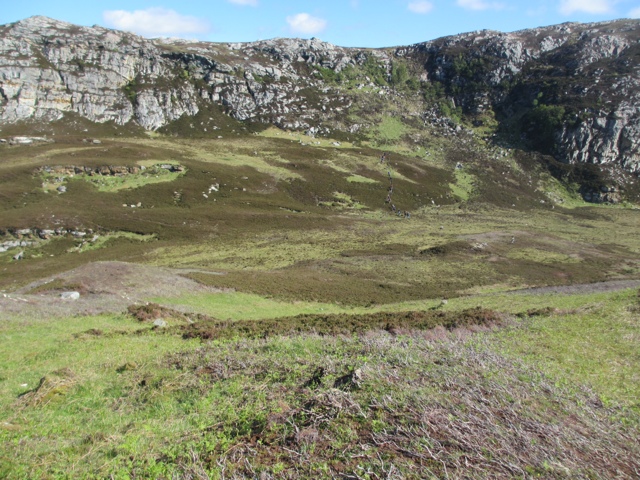
We kept climbing and climbing. I learned what a bog feels like, having accidentally tripped into one. They can be quite small scale. Also, I think I learned what the moss that changes to peat looks and feels like. When you fall on that, it is quite spongy and damp – doesn’t hurt at all.

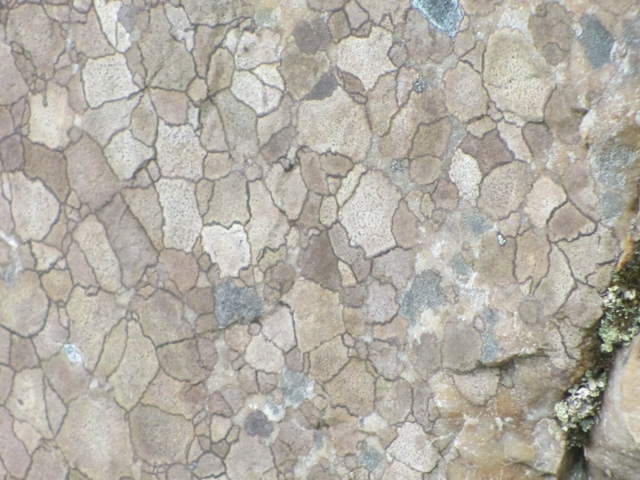
Part of what helped the geologists so long ago are “Pipe Rocks” which contain cylindrical burrows made by worms about 600. When the rocks these fossils burrows are squished or stretched or folded, the cylinders are as well. They are much easier to measure than rock grains, and those measurements help tell the rock’s story. They don’t photograph we’ll, but they attract an aggressive form of lichen that makes beautiful mosaic patterns on it.
Lunch was at another Geopark site, where they cleverly created a Stone Henge for geologists.
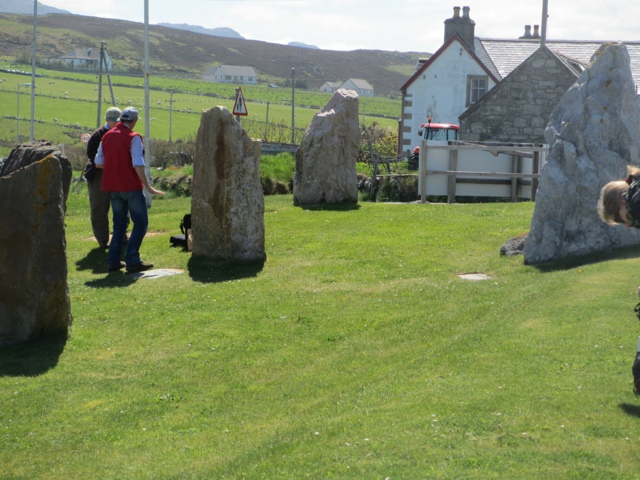
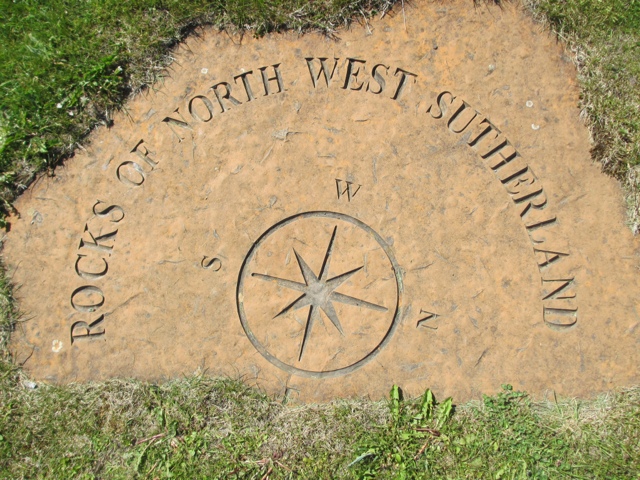
Each of the rocks was labeled with it’s name and age. This was in the center.
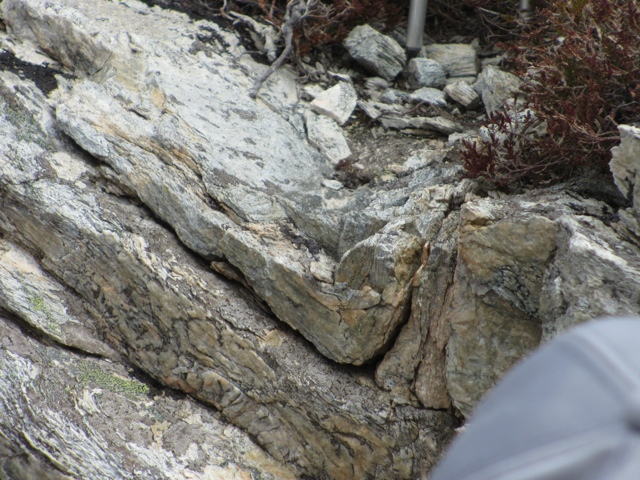
We saw all kinds of beautifully folded rocks.
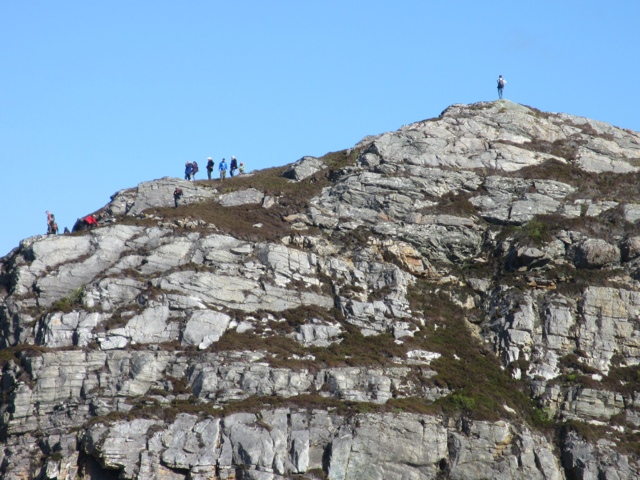
I stayed on one side of a valley while most of the other participants went across to look at more cool rock. But I was done for the day and soon went to sleep.
Highlands Day 2, sleep in Tongue

No wifi last night, so, sorry that didn’t go. But we are in the same hotel for three nights, and I will figure out how to post. 

Today we saw amazing geology, and I will post pictures, but what I think most of you will be interested in is the people we have met on this journey. But I don’t have pictures of them. 😦

Geology and pictures first.

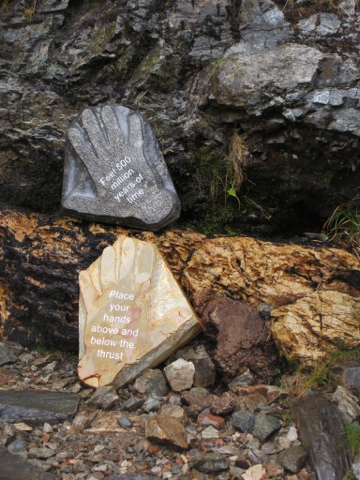
We visited the Moine Thrust. That is a bit ambiguous because the thrust area is several hundred km in area. But it is important to geology because it was the first area where people figured out how older rocks could be above younger rocks.

The idea is so non-intuitive that it took the scientific community a long time to agree that this is an area of crustal shortening, that a 55 km distance has been squished to 5 km. This is associated with rock parts being deformed from their original symmetrical shapes into elongated shapes.

Spectacular!

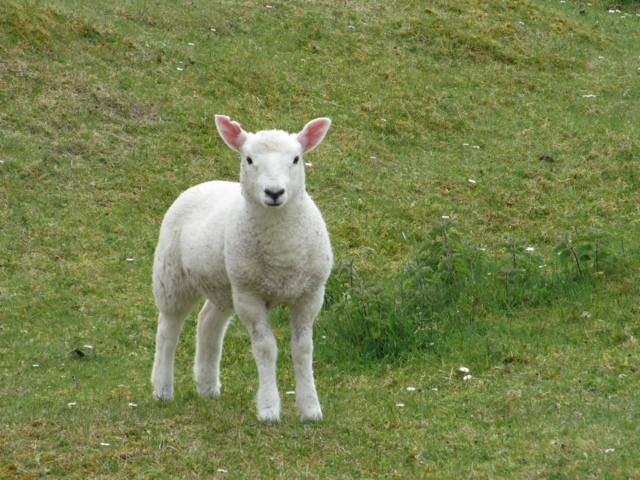
The sheep thought so, too.

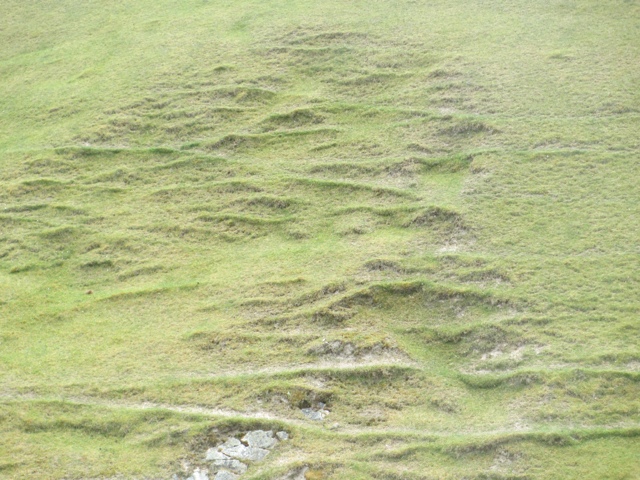
These guys have to deal with the steep topography, like we geologists do. They have made paths in the steeper parts of their fields that go sub-parallel to horizontal, just like many human cities have done.

It was more impressive in real life.

I am feeling sleepy. I will try for more about our new friends in the morning.

Good night.

Highlands Trip People

Thirty people, bused together in two main vehicles and two private cars, are getting to know each other. Less than half are from the US. Backgrounds vary astonishingly, from non geologists, to undergraduates, grad students who work in completely different kinds of terrains, grad student experts in structures similar to the ones we are seeing, professionals, retired professors, others. The questions asked of the leaders are all over the map, so to speak.

Last night I spoke with Michel from Poland, who is a grad student mapping Paleozoic and Mesozoic unmetamorphosed sediments. He started studying geology because he thought he would learn all about dinosaurs. He told me about the Polish dinosaur parks, it sounds like the same ones run by the team who looked at the Ridge as possible partners. What a fun coincidence! He is traveling with two colleagues, also both grad students.

Elaina from Barcelona recently published a paper about Dinosaur Ridge and Red Rocks. She sent a copy of it to my work email address. I think she is with a colleague, but I’m not sure. 

Miranda and Gus are from Venezuela. John, from Australia, is here alone but his wife will be meeting up with him after the geology trip. He was attacked by sea gulls, one of which nicked his head! I told him that his wife will never let him go on a geology trip again! (He laughed.) 

George from Arizona is president of the Geological Society of America, the group who organized this trip. Steve, from Chevron in Aberdeen wears a big cowboy hat. John, an undergraduate in Michigan, is president of his family’s business. He decided that the business was going well, so he could take some time for a field trip and (soon) a bachelor degree. Richard was born in Scotland but grew up in Hungary. He is seeing the back country for the first time. A possible relative of his, wearing the Scottish tartan for the same family name, is on this trip, too. They had never met before.

Two are from France, I think, but they don’t talk much. A few are from the UK, of course, one of those is a retired chemist ( we would say pharmacist ). Scott is a prof at USC, and his wife is from Germany.

One of the leaders is on a committee for the International Geoparks group, which is interesting because Dinosaur Ridge is applying to become an International Geopark right now. The other leader knew one of the UCLA professors that both Brian and I liked a lot when we were there. They are toasting him tonight, because he worked in this area of Scotland and became famous for brilliant ideas that are still being used.

Where do Brian and I fit in? I don’t know. Bottom line is that everyone is here to try to understand our Earth better. So we fit in quite well.

Highlands Day 1 (then sleep in Ullapool)

Incredible! Wandering around old rocks with people there to explain them to me. Pure JOY!

 The rocks we were studying today are all so old that the trip leaders say 2000 when they mean two thousand million years old. The youngest rocks we saw today were 470, older than any at Dinosaur Ridge or Red Rocks.

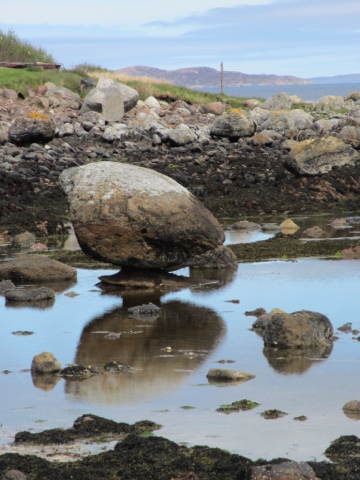
This was a funny one, eroded by the tides, now standing on a pedestal.

The people are like any geology field trip we have attended. Some older, younger,some know more and others less. They come from all over the world. We are traveling in two fifteen passenger vans. The front one has music on all the time and the back one is quiet. Today we are in the quiet one.

This is a structural geology field trip, so Brian and I are anomalous. A bit. But one of the leaders knows people we knew at UCLA, so we have some common topics. 

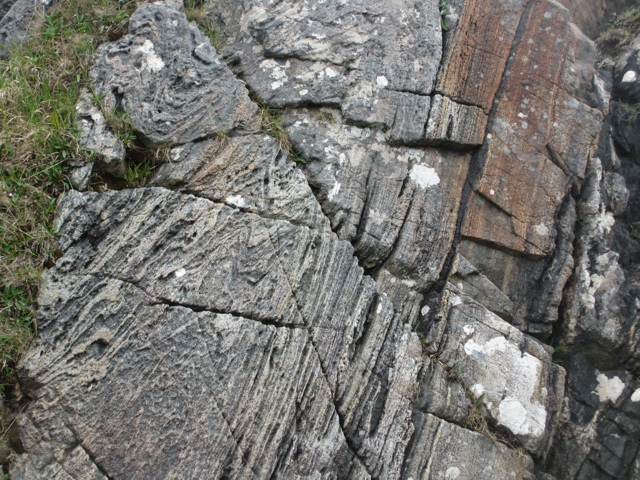
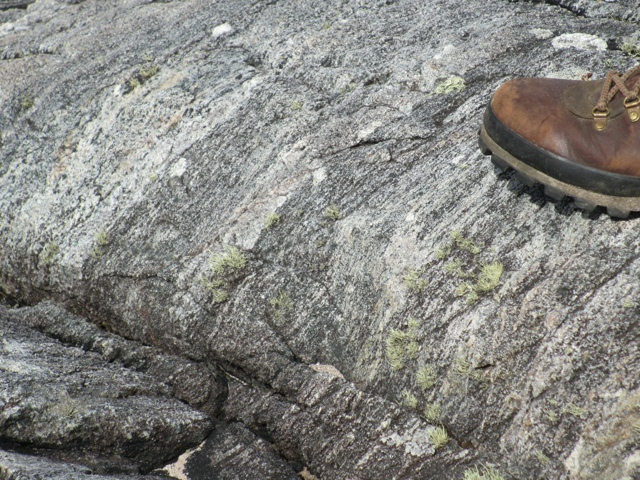
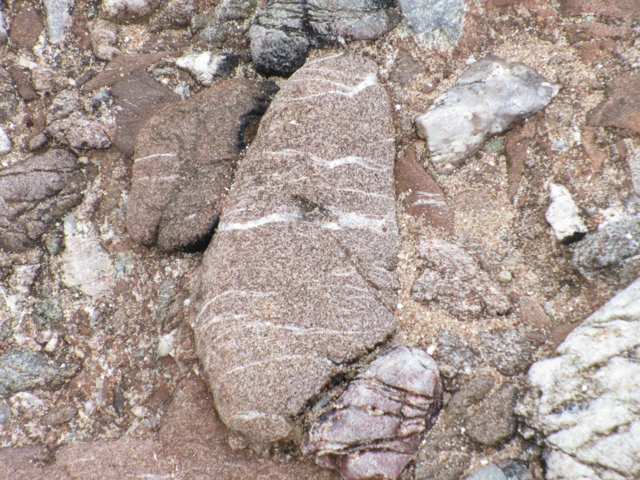
Striped rocks called gneiss show minerals in bands, caused by high pressure and temperature deformation. 

Today we saw a world class view of a thrust fault. I’ve never seen anything like it, a text book photo opportunity! Think of hard chocolate candy bars in frosting. The candy bars are all aligned, end to end, horizontal, and the frosting is above and Barlow the layer of candy bars. Then push them together, slowly with constant pressure. The candy bars would break apart and start stacking on top of each other. The rocks that did this now look a bit like dominoes that are laying partly on top of each other.

I was so enthralled with the explanation, I forgot to take a picture!

We also walked to an island at low tide, so we were able to get to it without getting wet. It is surrounded by water now. The 2400 rocks were complex, geochemically fascinating. I would have done a thesis on rocks like these if I had gotten a PhD.

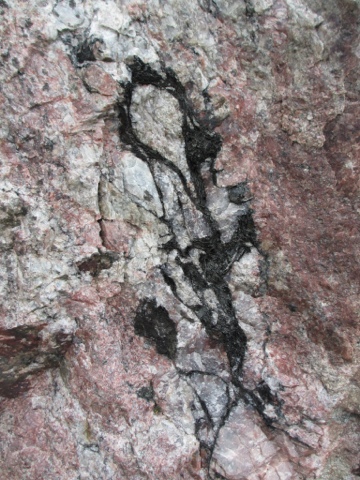
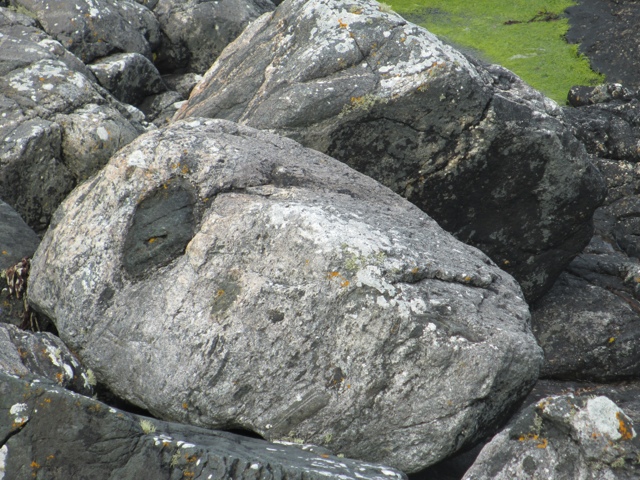
This one shows a black rock surrounded by light colored gneiss. Was the black one there first?

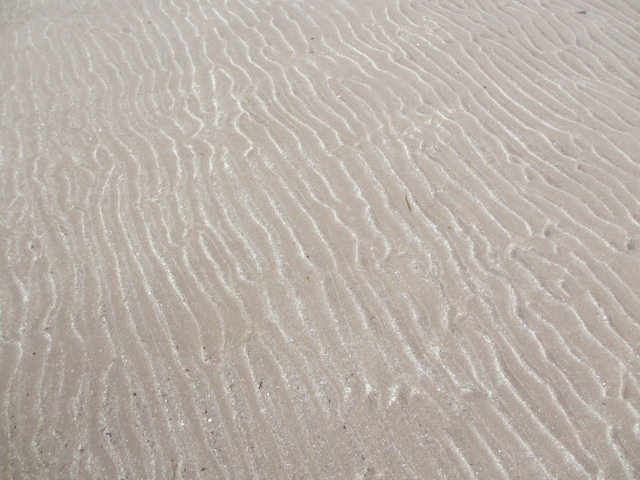
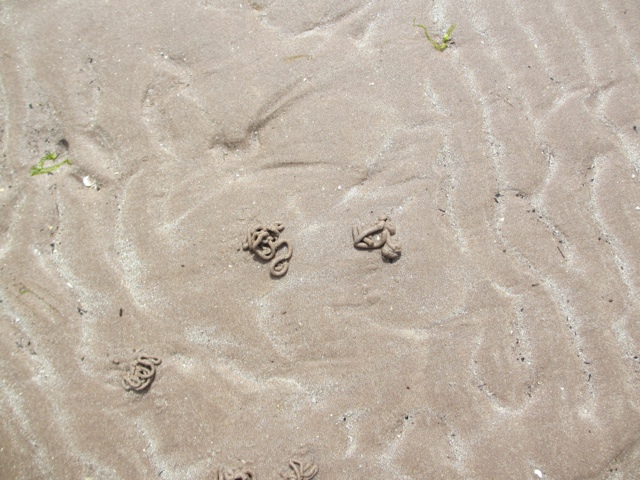
The tidal area we crossed showed ripple marks like what we have at Dinosaur Ridge. Those are one hundred. (Million years old) these were made today.

And there were some kinds of burrowing animals that left trace marks in the wet sand.

At another site, the breccia, which is a rock made up of big chunks of other rocks, like a Mrs. Fields cookie, some nuts, chips, oatmeal all cooked together. All the rocks inside the cookie dough part had cracks in them, filled with another mineral. Weird. And the filled cracks were aligned, so the thought is that they cracked under the same stress. I can not think of anything analogous. Marbles embedded in plastic? If you squish that, the marbles would crack but not the plastic. But then what filled the cracks? Β And why are they parallel?

Even though we were wearing strong boots, our feet are tired. Geology does not follow trails! But every step was worthwhile. A glorious day!